
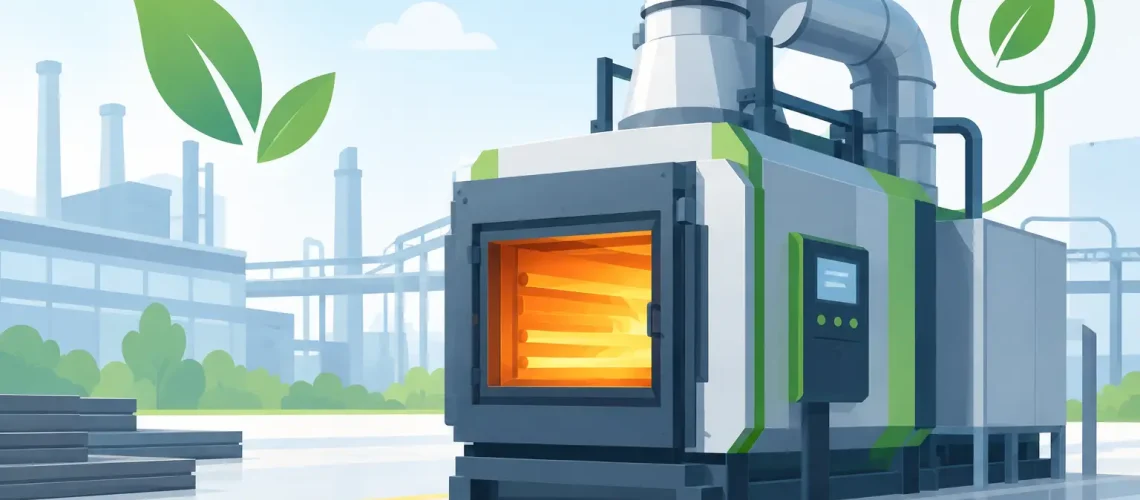
A furnace that reaches setpoint quickly but wastes heat through its walls, exhaust, or loading door is no longer a practical long-term asset. Future energy efficient furnaces are being defined by more than a high-efficiency heating element. They combine insulation, airflow, controls, loading design, recovery systems, and serviceability to deliver repeatable thermal results with less energy per part.
For plant managers and engineering teams, the question is not simply whether a furnace uses gas or electricity. The more useful question is how reliably the equipment transfers heat into the product, how much energy it loses between cycles, and whether its design supports the production schedule without increasing maintenance risk.
What Future Energy Efficient Furnaces Must Deliver
Industrial thermal processing has competing demands. A food production facility may prioritize sanitation and consistent drying. An automotive supplier may need controlled curing across different part geometries. Electronics and aerospace operations may require tight temperature uniformity, traceable process data, and careful protection of sensitive components.
The furnace of the future must meet these requirements while reducing avoidable energy consumption. That calls for an engineered system rather than a standard heating chamber selected only by internal dimensions.
Better insulation is only the starting point
Heat loss through furnace walls, doors, access panels, and ductwork directly affects operating cost. Modern high-performance insulation materials, properly designed door seals, and minimized thermal bridges can reduce that loss substantially. However, insulation alone does not solve inefficient operation.
A furnace that is oversized for the load will still consume unnecessary energy during warm-up and standby. One with poor door design may lose valuable heat every time an operator loads a trolley or fixture. For facilities that run frequent short batches, these details can matter as much as the burner or electric heater rating.
Custom chamber sizing, loading arrangements, and door configurations should therefore be evaluated against the actual process. The best design for continuous production may not be the best design for low-volume, high-mix work.
Precise control reduces waste and process variation
Temperature overshoot is costly twice. It consumes extra energy and can create inconsistent results, particularly in curing, drying, sterilization, and heat treatment processes. Advanced control panels with properly selected sensors, programmable logic, and stable power management allow the furnace to follow a defined temperature profile instead of repeatedly correcting large deviations.
Multi-zone control is especially useful in larger chambers or processes with uneven thermal loads. Rather than forcing the entire furnace to operate at a higher temperature to compensate for a cold area, independent zones can maintain a more balanced environment. This can improve product consistency while reducing excess heat input.
For many plants, process data is becoming equally valuable. Recording temperature, cycle time, alarms, and energy use helps maintenance teams identify drift before it becomes a failed batch or an unplanned shutdown. The practical value is not data for its own sake. It is faster troubleshooting, better quality records, and more informed operating decisions.
Heat Recovery Has a Stronger Role in Furnace Design
Exhaust air often carries heat out of the process that could be used elsewhere. Future-focused furnace projects increasingly assess whether this energy can preheat incoming combustion air, fresh process air, water, or the next production stage.
Heat recovery is not suitable for every application. Contaminants, moisture, corrosive vapors, cleaning requirements, and space limitations must be considered carefully. In sanitation, food, coating, or chemical environments, recovered heat may require separation or additional filtration to prevent cross-contamination.
Where conditions allow, recovery can improve the total efficiency of an operation rather than only the furnace itself. A drying line, washer, ventilation system, or preheating stage may benefit from energy that would otherwise leave through the stack. This is where custom engineering becomes valuable: the furnace should work as part of the facility, not as an isolated machine.
Electrification Changes the Decision, Not the Need for Engineering
Electric furnaces are receiving more attention as facilities pursue lower onsite emissions and as grid electricity becomes cleaner in some regions. Electric heating can offer responsive control, clean operation at the point of use, and simpler integration for certain processes. It can be particularly attractive where product cleanliness, indoor air quality, or precise temperature management is a priority.
But electrification is not automatically the lowest-cost answer. Local electricity rates, demand charges, available site capacity, operating hours, required temperature range, and the existing gas infrastructure all affect the business case. A high-power electric furnace may require upgrades to switchgear, cabling, transformers, or power distribution before installation.
Gas-fired equipment can remain an effective choice when designed for high combustion efficiency, controlled airflow, low standby losses, and the actual production load. Hybrid strategies may also make sense. For example, a facility can electrify lower-temperature drying or sterilization processes while retaining gas-fired capacity for applications where energy economics or high-temperature performance favor it.
The right choice begins with a process review, not a technology preference.
Airflow and Loading Design Are Energy Decisions
Uniform airflow is often discussed as a quality issue, but it is also an energy issue. If hot air does not reach all surfaces of the load evenly, operators may extend cycle time or raise the setpoint to ensure the coldest area meets requirements. Both responses increase energy consumption.
Well-designed recirculation, fan selection, duct placement, and baffle arrangements help move heat where it is needed. The load itself must be part of that design. Dense racks, tightly packed trays, solid fixtures, and irregular product shapes can restrict airflow and create cold zones.
A custom furnace should account for how operators load it every day. Trolley dimensions, rack spacing, door opening direction, ergonomic access, and batch size influence cycle consistency. A design that looks efficient on paper but encourages poor loading practices will not deliver its expected savings on the plant floor.
Maintenance Must Be Designed Into Efficiency
Energy performance degrades when door gaskets leak, sensors drift, fans lose performance, burners fall out of adjustment, or insulation becomes damaged. The most efficient furnace design is of limited value if routine inspection requires excessive downtime or inaccessible components.
Future-ready equipment should make critical service points practical to inspect. This includes access to heating components, fan assemblies, control panels, sensors, filters, seals, and safety devices. Clear alarm functions and control diagnostics can help teams address small issues before they affect production.
Preventive maintenance also protects safety. Thermal equipment operates with high temperatures, electrical systems, moving airflow components, and, in some cases, combustible fuel. Regular checks support stable performance while reducing the risk of failed controls, overheating, or unexpected stoppages.
For facilities without dedicated thermal-process specialists, supplier support matters. Installation, commissioning, operator guidance, spare-parts planning, and responsive technical service are all part of sustaining efficiency over the equipment lifecycle.
How to Evaluate a Furnace Investment
Procurement teams should look beyond the initial equipment price and rated efficiency. The most useful comparison considers energy per batch or per unit produced, warm-up time, standby losses, expected maintenance requirements, temperature uniformity, production flexibility, and the expected working life of the machine.
Ask suppliers to assess the real process conditions: product mass, moisture content where relevant, target temperatures, cycle profiles, load frequency, available utilities, floor space, ventilation, and safety requirements. A furnace designed around these operating facts is more likely to deliver measurable savings than a generic unit selected from a catalog.
REK Engineering Machinery approaches thermal equipment as a complete production solution, combining custom fabrication, control integration, installation, and ongoing technical support. That approach is especially relevant when a furnace must fit an existing line, support specialized loading methods, or meet sanitation and process-control requirements without compromising reliability.
The next generation of furnace efficiency will come from disciplined engineering choices: right-sized chambers, controlled heat transfer, sensible energy recovery, maintainable components, and controls that keep every cycle on target. A well-designed furnace does more than lower utility use. It gives operations teams a more predictable process to build on as production demands change.