
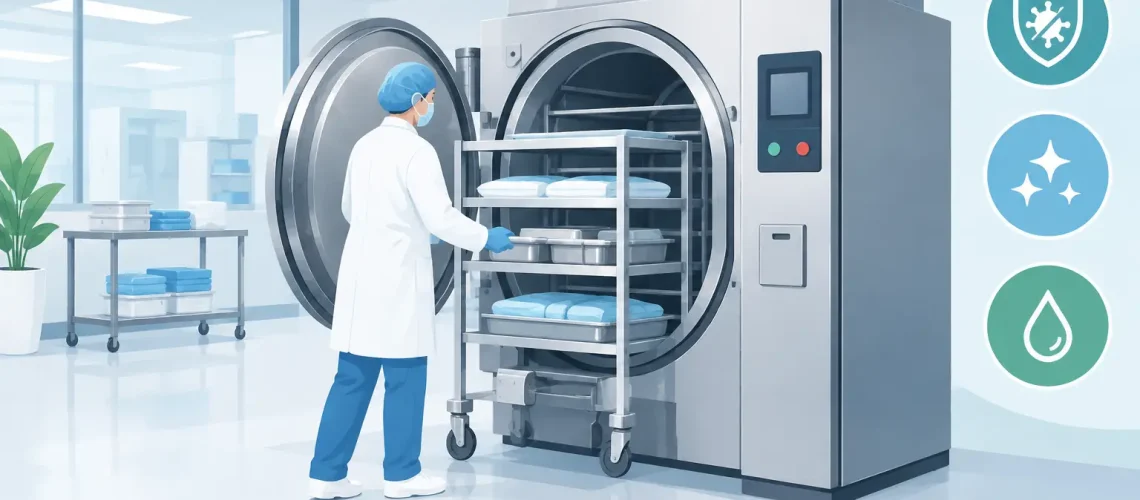
A sterilization process is only as dependable as its repeatability. If a hospital trolley, production fixture, food-contact component, or reusable textile leaves the machine without receiving the required exposure, the problem is not simply cleanliness. It can affect product quality, staff safety, audit readiness, and the confidence of everyone relying on the process. Industrial sterilizers are built to control that risk at scale through managed temperature, time, airflow, loading, and safety conditions.
For facilities with high throughput or specialized sanitation requirements, the right machine is rarely a standard box with a heater. It is an engineered part of the workflow. Capacity, load type, process temperature, cycle time, utilities, material handling, and maintenance access all influence whether a sterilizer delivers consistent daily results.
What Industrial Sterilizers Must Deliver
Industrial sterilizers apply a controlled process to reduce or eliminate viable microorganisms on equipment, materials, or reusable items, depending on the validated application and method used. In practical terms, operators need more than heat. They need a process that reaches the load consistently, holds the required conditions for the required duration, and can be operated safely from one shift to the next.
The required result depends on the facility. A healthcare environment may need a documented cycle for medical support equipment or transport trolleys. A food operation may focus on sanitation of tools, containers, or contact surfaces between production runs. In manufacturing, sterilization or high-temperature sanitation may support cleanroom protocols, contamination control, or controlled handling of parts.
This distinction matters because not every thermal machine is a sterilizer, and not every cleaning process achieves sterilization. Washing removes soils. Drying removes moisture. Disinfection reduces many harmful organisms. Sterilization has a more specific performance requirement and should be selected, operated, and validated accordingly. The process target must be defined before equipment is specified.
Start With the Load, Not the Machine
The most useful specification begins with what will enter the chamber. A stainless-steel trolley, porous textile bundle, polymer component, instrument tray, and food-processing rack do not absorb and release heat in the same way. Their size, mass, geometry, packaging, and loading pattern affect heat transfer and cycle performance.
A facility should first establish the dimensions and maximum weight of a typical load, as well as the largest occasional load. It should also identify whether items are open, enclosed, stacked, wheeled, bagged, or placed in baskets. A machine that appears large enough on paper can still perform poorly if airflow is blocked or if operators must load it in ways that create cold areas.
Material compatibility is equally important. Some plastics, seals, coatings, and electronic components cannot tolerate elevated temperatures. Some loads require drying after treatment, while others must remain protected from recontamination during transfer. These factors determine whether a dry-heat, steam-based, hot-air, or other sterilization approach is appropriate.
For many industrial applications, custom chamber dimensions and trolley configurations provide a better fit than adapting the operation to an undersized standard unit. Purpose-built racking, guided loading, and clear separation between clean and unclean areas can make the process safer and easier to manage.
Choosing the Right Sterilization Method
There is no single best method for every operation. The correct choice depends on the load, the hygiene objective, available utilities, required throughput, and applicable standards.
Dry Heat and Hot-Air Systems
Dry-heat systems use controlled heated air and are often suitable for materials that can tolerate higher temperatures and do not require moisture. Their performance depends on chamber insulation, heater capacity, airflow design, temperature uniformity, and accurate controls. They can be a practical option for metal items, certain glassware, trolleys, racks, and industrial components.
The trade-off is that dry heat may require longer exposure times or higher temperatures than steam-based methods. For loads with complex geometry, high density, or sensitive surfaces, the process needs careful engineering and validation.
Steam-Based Sterilization
Steam transfers heat efficiently and is widely used where compatible materials and facility utilities allow it. It can be highly effective for many healthcare, laboratory, laundry, and food-related applications. However, steam quality, drainage, condensate management, pressure control, and drying performance all affect results.
A steam process is not automatically suitable for every facility. Loads that are moisture-sensitive, corrosion-prone, or difficult to dry may require a different approach. The installation also needs dependable water, steam generation or supply, drainage, and appropriate safety provisions.
Thermal Trolley Sterilizers
Trolley sterilizers are designed for facilities that need to process carts, transport trolleys, racks, bins, and other large reusable handling equipment. These machines can help maintain hygiene across healthcare corridors, central kitchens, food plants, laundry operations, and production areas where mobile equipment moves continuously between zones.
The engineering challenge is achieving effective exposure around the full trolley rather than only the surfaces closest to the heat source. Chamber size, door sealing, air circulation, trolley wheel design, and loading orientation all need attention. A well-designed unit should also support safe movement of heavy loads without creating a bottleneck at the sanitation point.
Process Control Is Where Reliability Is Won
A sterilizer should provide clear control of temperature, time, alarms, and operating status. For critical applications, facilities may also require data recording, cycle reports, user access levels, sensor verification, and traceability that supports internal quality procedures or external audits.
Temperature uniformity deserves particular attention. A display may show that the chamber has reached its setpoint, but the relevant question is whether the most challenging location in the load has reached and maintained the required condition. Equipment design, sensor placement, airflow, load arrangement, and cycle development all contribute to that answer.
Controls should be practical for the people operating the machine. A complex interface can create avoidable errors during busy shifts. Clear recipes, visible status indicators, fault messages that guide action, and interlocks that prevent unsafe door opening help turn a technical process into a dependable routine.
Safety is not an optional feature. High temperatures, pressurized systems, heavy trolleys, wet floors, and powered doors introduce real risks. Appropriate insulation, door locking, emergency stops, overload protection, guarding, and electrical protection should be considered as part of the complete installation. The machine must also be serviceable without exposing technicians to unnecessary hazards.
Design for Throughput and Daily Operation
When selecting capacity, it is tempting to choose the largest chamber available. That is not always the most efficient answer. An oversized machine running partial loads can waste energy and lengthen handling time, while an undersized machine can force rushed cycles and create queues of unprocessed equipment.
The right capacity is based on peak demand, not just average daily volume. Consider how many loads arrive during the busiest hour, how long each cycle takes including loading and unloading, and whether operators need time for inspection, cooling, or documentation. If the operation runs multiple shifts, maintenance windows must also be included in the calculation.
Energy performance comes from more than heater efficiency. High-quality insulation, efficient airflow, well-sealed doors, sensible chamber sizing, standby controls, and reduced rework all contribute to lower operating demand. A durable machine that holds stable conditions and requires fewer unplanned repairs can be more economical over its service life than a lower-cost unit with inconsistent performance.
Installation planning should cover floor loading, access routes, ventilation, electrical supply, water and drainage where applicable, and the path of clean and unclean materials. In many projects, a layout review before fabrication prevents expensive changes after delivery.
Why Custom Engineering Matters
Off-the-shelf equipment can be appropriate for simple, predictable loads. But facilities often have space constraints, unusual trolley dimensions, specific handling procedures, or internal hygiene rules that do not fit a catalog model. In these situations, custom engineering can improve both process control and operator acceptance.
REK Engineering Machinery supports industrial sterilization projects with custom fabrication, control-panel engineering, installation, and after-sales maintenance. The goal is not to add complexity. It is to create equipment that fits the actual load, facility layout, utility conditions, and operating routine.
A successful project also includes planning for calibration, preventive maintenance, replacement parts, and technical support. Even a well-built sterilizer can lose consistency when door seals wear, sensors drift, airflow paths become restricted, or operators change loading practices. Routine inspection protects process performance and extends equipment life.
The best sterilizer is the one your team can run correctly every day, verify with confidence, and maintain without disrupting the operation. Start with the load and the hygiene objective, then build the equipment and process around the realities of your facility.