
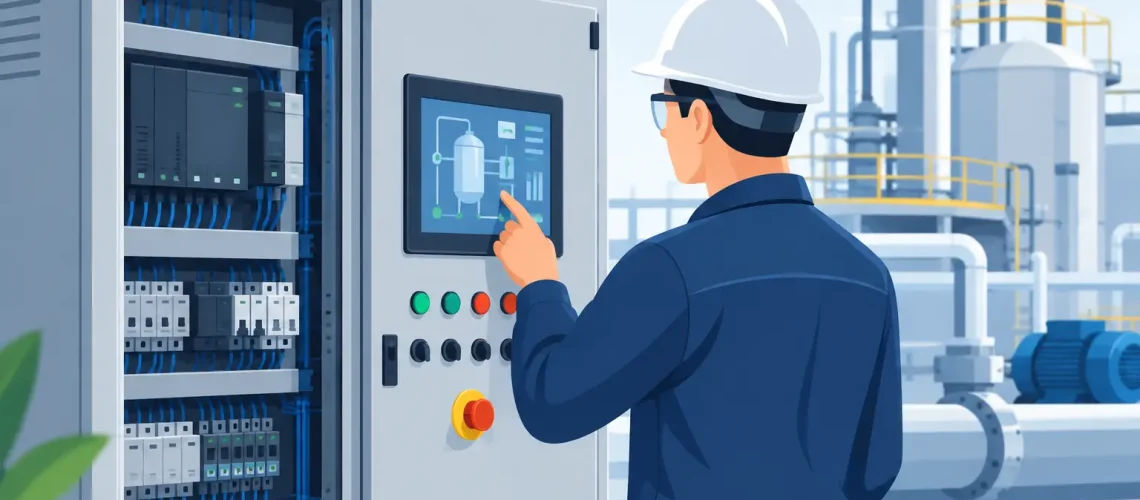
A curing oven that reaches temperature but cannot hold it consistently still creates rejects. A washer with strong mechanical performance but poorly coordinated pumps, heaters, and safety interlocks creates downtime. In both cases, control panels determine whether the equipment operates as a dependable production asset or a recurring source of uncertainty.
For facilities running thermal processing, sanitation, drying, washing, or sterilization equipment, the panel is more than an electrical enclosure. It is the operating center that translates a process requirement into repeatable machine behavior. The right design helps operators run equipment safely, gives maintenance teams useful fault information, and allows management to protect quality without adding unnecessary complexity to the floor.
What Industrial Control Panels Must Deliver
Industrial machinery works under real operating conditions: changing loads, heat, moisture, dust, repeated cycles, shift changes, and production pressure. Control panels must manage these conditions while keeping the machine within its intended operating limits.
At a practical level, a panel receives information from devices such as temperature sensors, level switches, pressure controls, door interlocks, emergency stops, and motor protection devices. It then makes decisions through a programmed controller or relay logic and sends commands to heaters, blowers, pumps, conveyors, alarms, and other components. The value is not in adding controls for their own sake. It is in making the process predictable.
For example, an industrial oven may need staged heating, controlled airflow, timed dwell periods, and a cool-down sequence before a door can be opened. A trolley sterilizer may need to verify door closure, water level, temperature, and cycle completion before releasing the load. These functions should work together in a clear sequence that reflects the facility’s actual workflow.
The design also needs to suit the application. A simple manual process may be better served by straightforward controls that are easy to diagnose. A high-volume operation with product traceability requirements may justify programmable logic control, recipe management, data collection, and a more detailed human-machine interface. More automation is not automatically better. The appropriate level depends on process risk, operator skill, production volume, and maintenance resources.
Designing Control Panels Around the Process
A control panel should be specified after the process is understood, not before. Generic enclosures and standard wiring layouts can be useful starting points, but they often fail to address the conditions that cause expensive interruptions later. A good engineering discussion begins with the load, the environment, the cycle, and the people who will operate the machine.
Start with operating requirements
The first questions are operational. What must the machine heat, wash, cure, dry, or sterilize? What temperatures, cycle times, airflow rates, or wash stages are required? What happens if a sensor fails, a door is opened, a motor overloads, or utility power is interrupted?
These details determine the control logic and the protective devices required. They also define what information an operator needs to see. In a food facility, a clearly displayed cycle status can help prevent a load from being removed too early. In an aerospace or electronics coating process, temperature deviation alarms may be central to quality assurance. In a laundry or healthcare environment, the control sequence may need to prevent cross-contamination between clean and soiled handling stages.
Select components for the duty cycle
Control components should match the electrical load and operating environment. Contactors, circuit breakers, overload relays, variable frequency drives, power supplies, terminal blocks, and temperature controllers all have different roles, but their selection must work as a system.
Heat is a frequent concern. Panels installed near ovens, furnaces, dryers, or spray booths may require careful enclosure sizing, ventilation, component spacing, or cooling measures. Placing sensitive electronics in an excessively hot cabinet can shorten component life and make fault behavior inconsistent. Conversely, adding cooling without considering dust, moisture, and service access can introduce a different maintenance problem.
Electrical supply conditions matter as well. Facilities may have different voltage standards, available fault current levels, grounding practices, and backup power arrangements. A panel designed for one site should not be assumed to suit another without review. This is especially relevant for businesses operating across multiple countries or expanding an established process to a new plant.
Build safety into the control logic
Industrial safety is not limited to an emergency stop button on the door. A proper design considers how the machine should respond to foreseeable events. Thermal equipment may need independent over-temperature protection. Washers may need low-water protection to avoid heater damage. Spray and ventilation systems may need interlocks that prevent operation when airflow is inadequate.
The safest response is not always an immediate full shutdown. In some processes, controlled cooling, extraction fan operation, or a managed stop sequence may be necessary to protect personnel and equipment. The required response should be defined during engineering, documented clearly, and tested during commissioning.
Operators also need controls they can understand under pressure. Clear labels, logical grouping, visible status indication, and simple alarm messages reduce mistakes. A screen filled with unexplained codes may look sophisticated, but it does little to help an operator recover from a stoppage safely.
Control Panels and Process Consistency
Consistency is where well-designed controls provide their strongest business value. When equipment repeats the same validated sequence, facilities can reduce variation caused by manual timing, missed steps, or uncertain settings. That can mean more uniform curing, dependable drying results, repeatable wash cycles, or better sanitation control.
Temperature management illustrates the point. The panel does not create heat by itself, but it coordinates heater stages, sensor feedback, fan operation, and safety limits. If the system has been correctly designed and tuned, it can hold the process closer to its target conditions despite normal load changes. If sensors are poorly located or the logic does not account for the machine’s thermal response, a high-quality controller alone will not solve the problem.
This is why the machinery and the controls should be engineered together. An undersized blower, unsuitable heater arrangement, leaking chamber, or poorly insulated enclosure can create control issues that no amount of programming can fully correct. Facilities receive better results when the panel is part of a complete equipment solution rather than a separate afterthought.
For custom machinery, controls can also preserve knowledge. Recipes, sequence parameters, alarm limits, and operator prompts place critical process steps into the machine rather than relying only on individual experience. That supports training, shift-to-shift consistency, and easier handover when staffing changes.
Maintainability Should Be Designed In
A control panel is easier to value over its full service life when technicians can inspect, troubleshoot, and replace components efficiently. Organized wiring, durable labeling, accessible terminals, current electrical drawings, and sensible spare-part selection all reduce the time spent identifying a fault.
Preventive maintenance should include more than checking whether the machine starts. Teams should inspect connections for heat damage or loosening, verify cooling and enclosure cleanliness, test safety devices, review alarm history, and confirm that sensors remain accurate. The right inspection interval depends on the process environment and operating hours. A panel beside a high-temperature furnace or in a humid wash area generally needs closer attention than one in a clean, climate-controlled production room.
Alarm design deserves particular care. An alarm should tell the team what condition occurred and what action is appropriate. Repeated nuisance alarms train people to ignore warnings, while overly broad fault messages slow diagnosis. Useful alarm information can help distinguish between a process issue, a failed field device, an electrical supply problem, or a mechanical condition such as restricted airflow.
REK Engineering Machinery approaches controls as part of the complete machine lifecycle, from custom design and installation through maintenance and technical support. That continuity matters because the team servicing the equipment needs to understand not only the wiring diagram, but also the production or hygiene objective behind each control sequence.
When to Upgrade an Existing Panel
An older panel does not always need full replacement. If the equipment remains mechanically sound and the control logic still suits the process, selective upgrades may improve reliability at a reasonable cost. Replacing obsolete devices, improving labeling, adding safety interlocks, or updating temperature control can address specific risks without rebuilding the entire system.
A full redesign is often justified when spare parts are no longer available, electrical capacity has changed, repeated faults are affecting output, or the machine must meet a significantly different process requirement. It may also be the better choice when modifications have accumulated over many years and the original wiring no longer reflects the equipment’s actual operation.
Before approving an upgrade, review the machine’s failure history, operating constraints, future production plans, and serviceability. The lowest initial price can be misleading if it creates another difficult-to-maintain panel with limited diagnostic capability. A sound solution balances capital cost with safety, uptime, component availability, and the skills available at the site.
The most useful control panels make complex industrial work easier to run, safer to maintain, and more consistent to verify. When the panel is designed around the real process and supported throughout its service life, it becomes a practical foundation for dependable daily production.