
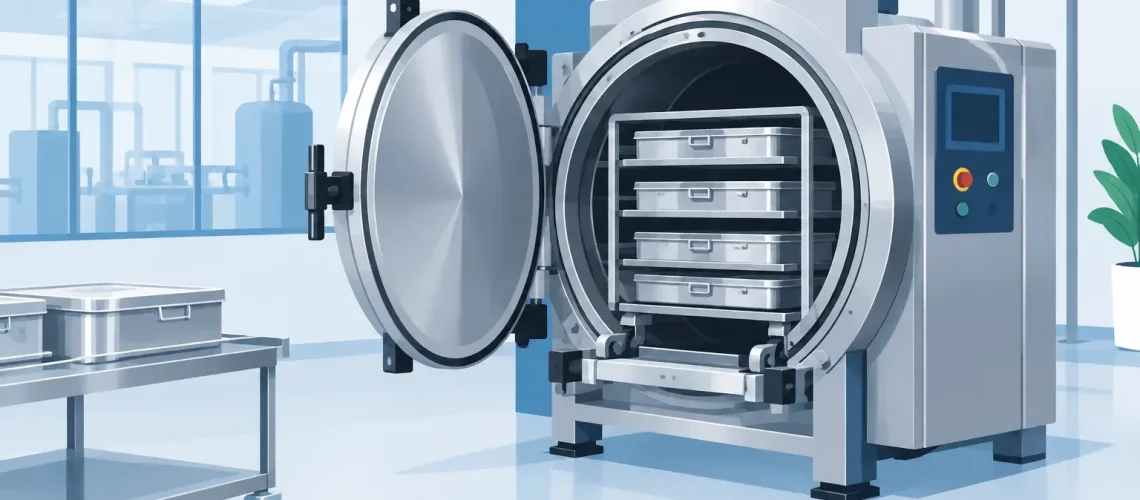
A sterilization system can look fully capable on a specification sheet and still create delays, excess utility costs, or inconsistent results once it reaches the facility floor. A meaningful sterilization equipment review therefore begins with the actual load, contamination risk, workflow, and evidence required to prove the process has worked. For hospitals, food plants, commercial laundries, manufacturers, and hygiene-sensitive operations, the right machine is not simply the one that reaches temperature. It is the one that delivers a repeatable, safe, supportable cycle within the realities of daily production.
What a Sterilization Equipment Review Should Measure
Sterilization is a controlled process intended to eliminate viable microorganisms to a defined assurance level. This differs from routine cleaning or disinfection, which may reduce contamination without achieving sterilization. That distinction affects equipment selection, operating procedures, validation requirements, and the records a facility must retain.
A sound review considers more than chamber size and heating capacity. It asks whether the machine can process the required item type, whether the load will be exposed evenly, and whether the cycle can be documented and repeated across shifts. The evaluation should also account for loading and unloading time, operator access, floor layout, utilities, preventive maintenance, and the availability of technical support.
The correct standard depends on the application. A facility handling reusable medical items, food-contact equipment, laundry trolleys, production tools, or contaminated containers may each need a different process. There is no universally best sterilizer. There is only equipment that is properly matched, validated, and maintained for a specific duty.
Start With the Load, Not the Machine
The load determines nearly every meaningful design decision. Before comparing equipment, define what will enter the chamber: its dimensions, material, mass, packaging, surface geometry, moisture content, and expected contamination level. A stainless-steel trolley, porous textile load, heat-sensitive component, and sealed instrument pack do not behave the same way during a thermal cycle.
Dense loads heat more slowly than open, lightweight loads. Items with narrow channels, layered surfaces, or enclosed areas can develop cold spots if airflow or steam penetration is inadequate. Wet materials may require drying capacity after treatment, while certain plastics, adhesives, coatings, and electronic components may limit the usable temperature range.
Throughput matters just as much as chamber volume. A large chamber may seem productive, but it can become inefficient if it operates partially loaded or creates a bottleneck during loading, cooling, or unloading. Conversely, a smaller machine with shorter validated cycles may better support continuous operations. Review daily volume, peak demand, shift pattern, and contingency requirements rather than selecting capacity based only on the largest occasional load.
Questions to Resolve Before Procurement
A procurement team should be able to state the required cycle outcome, the typical and maximum load, the daily number of cycles, and the allowable turnaround time. It should also identify the available electrical supply, water quality, drainage, ventilation, compressed air, and floor space.
These practical details prevent expensive changes after installation. They also reveal when a custom chamber size, trolley arrangement, door configuration, or control sequence is more appropriate than a standard catalog machine.
Compare Sterilization Methods by Process Fit
Thermal sterilization equipment commonly relies on steam, dry heat, or other controlled heating methods. Each method has benefits and limitations, so the review should focus on material compatibility and process assurance rather than broad claims of superiority.
Steam-based systems are often effective for loads that tolerate moisture and elevated temperatures. Their performance depends on reliable steam quality, air removal, penetration, pressure control, and complete exposure at the specified conditions. They are widely used where validated moist-heat processing is suitable, but they may not be suitable for moisture-sensitive components or materials that corrode, deform, or retain water.
Dry heat systems can be appropriate where moisture is undesirable, such as certain metal tools, glassware, or heat-stable components. However, dry heat generally requires higher temperatures or longer exposure periods than steam processes. Chamber uniformity, recirculating airflow, insulation, door sealing, and accurate temperature sensing become especially important.
Trolley sterilizers and purpose-built hygiene systems are often selected for high-contact mobile equipment used in healthcare, food handling, laundry, and production environments. Their value comes from treating the complete trolley or transport unit in a controlled enclosure rather than relying on inconsistent manual cleaning. The right design must accommodate trolley dimensions, wheel placement, drainage, loading access, and safe operator handling.
Some facilities require a combined process that includes washing, sterilization, and drying. A separate machine may offer more flexibility, while an integrated system may reduce manual transfers and contamination risk. The better choice depends on available space, labor flow, validation needs, and whether each stage must be independently controlled.
Validation Is the Difference Between Heating and Sterilizing
A chamber display showing the target temperature is not, by itself, evidence that every part of a load received the required process. Validation establishes that the system consistently performs as intended under defined operating conditions.
During commissioning, the facility should confirm temperature distribution, heat penetration, cycle timing, alarm response, interlocks, and recording accuracy. Sensors should be calibrated, and test loads should reflect normal operating conditions rather than an ideal empty chamber. If the load changes significantly, the cycle may need to be reassessed.
Data recording is a practical requirement, not an administrative burden. Operators and quality teams need a clear record of cycle parameters, exceptions, alarms, and completed batches. Controls should be intuitive enough for routine use while providing secure process visibility for supervisors and maintenance personnel.
Ask how the equipment handles a failed cycle. Does it prevent release of the load? Does it retain the fault history? Can it identify a door-seal issue, sensor deviation, heater fault, low utility condition, or interrupted cycle? A machine that communicates problems clearly protects both process integrity and operating time.
Review Safety, Access, and Daily Usability
Sterilization equipment operates with high temperatures, pressurized media, electrical power, and potentially contaminated loads. Safety should be designed into the machinery, not left to operator caution alone.
Review door interlocks, emergency stops, thermal insulation, pressure relief provisions where applicable, guards, warning indicators, and safe loading heights. For pass-through installations, consider whether separate clean and contaminated sides improve workflow and reduce cross-contamination. Doors, trolleys, and controls should suit the movement patterns of the people who use them every day.
Maintenance access is often overlooked during the purchase stage. Heating elements, blowers, filters, sensors, valves, drains, control panels, and door seals must be reachable without dismantling major sections of the machine. A well-built enclosure with difficult service access can still become a costly operational problem.
The interface also matters. Operators should be able to select approved cycles, see process status, respond to alarms, and follow loading instructions without unnecessary complexity. At the same time, authorized personnel should be able to protect validated settings from accidental changes.
Energy Use Must Be Viewed Across the Full Cycle
Energy-conscious equipment is not defined only by its rated power. The real question is how much energy and utility input are required for each completed, usable load. Heat loss through poorly insulated chambers, long warm-up periods, uncontrolled exhaust, repeated idle operation, and oversized equipment can all increase operating cost.
Review insulation quality, heat recovery opportunities, chamber sealing, control logic, standby settings, and cycle scheduling. Faster is not automatically more efficient if a shortened cycle produces uneven treatment or requires rework. Likewise, a longer cycle may be justified when it improves load capacity, drying performance, or process certainty.
Utility reliability should be part of the evaluation. A machine designed around unstable power, poor water quality, or inconsistent steam supply may experience avoidable downtime. Suitable filtration, electrical protection, drainage design, and control safeguards can extend service life and reduce disruptions.
The After-Sales Test: Can the Equipment Stay Productive?
The initial purchase price is only one part of the ownership decision. Downtime caused by a failed heater, worn seal, damaged controller, or unavailable spare part can cost far more than a modest difference in capital cost. Review the supplier’s installation process, operator training, commissioning support, maintenance scope, spare-parts availability, and response capability before finalizing the purchase.
Custom-built machinery can provide a stronger long-term fit when standard equipment does not match the load or facility layout. It should not mean accepting an unproven design. The supplier should clearly explain the engineering basis, materials of construction, controls, safety features, test plan, and service requirements.
REK Engineering approaches sterilization and hygiene equipment as part of a complete facility process, from custom fabrication and installation to maintenance and technical support. That partnership model is especially valuable when a facility needs equipment that fits an established workflow instead of forcing the workflow to fit the machine.
A disciplined sterilization equipment review leads to a more dependable purchase decision. Choose equipment that can prove its process, fit the real load, protect operators, and remain serviceable after years of demanding use. When those conditions are met, sterilization becomes a controlled part of operations rather than a recurring source of uncertainty.