
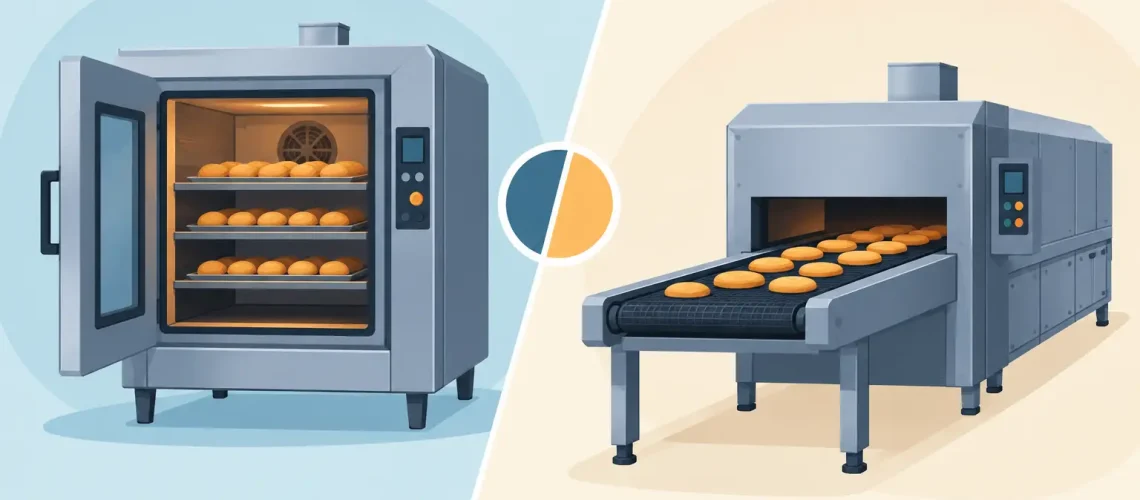
A curing line that waits for an oven door to open can become the constraint that limits an entire production shift. On the other hand, a continuously moving conveyor system can be an expensive mismatch when product sizes change frequently or production runs are intermittent. The decision between batch ovens versus conveyor ovens should start with the process, product flow, and operating requirements – not with a preference for one oven style.
Both systems can deliver controlled heating, drying, baking, curing, annealing, preheating, or sterilization support. The right choice depends on how material enters the process, how consistently it must move, how much variation the facility handles, and what level of control is needed for each load.
Batch Ovens Versus Conveyor Ovens: The Core Difference
A batch oven processes a defined load at one time. Parts are placed on racks, carts, trays, or trolleys, the chamber is closed, and the programmed cycle runs for a specified time and temperature. Once the cycle is complete, the load is removed and the next batch begins.
A conveyor oven moves products continuously, or in indexed steps, through one or more heated zones. Products enter at one end, travel through the controlled thermal process, and exit at the other. Conveyor systems are often integrated directly with upstream and downstream operations such as coating, washing, assembly, packaging, or cooling.
The distinction sounds simple, but it affects layout, labor, utility demand, product quality, maintenance planning, and the facility’s ability to respond to changing orders. A batch oven is built around cycle control. A conveyor oven is built around production flow.
When a Batch Oven Is the Better Fit
Batch ovens are particularly effective when products vary in shape, mass, dimensions, or processing requirements. A manufacturer may process a large fabricated frame in the morning, smaller assemblies in the afternoon, and a low-volume specialty component later in the week. With appropriately designed racking and controls, one chamber can support those different jobs without reconfiguring an entire production line.
This flexibility is valuable in job shops, aerospace work, maintenance operations, prototype production, custom metal fabrication, and facilities with frequent product changeovers. It can also suit sanitation or drying applications where carts, instruments, garments, containers, or equipment components are loaded as complete groups.
A batch system gives operators clear control over dwell time. The entire load can be held at a required setpoint for the necessary duration, which helps when the process specification is based on a full-cycle exposure. Multi-step recipes can support ramping, soaking, controlled cooling, alarms, and data recording where required.
Batch ovens also make practical sense when daily volume is moderate rather than constant. Running a conveyor oven for short or irregular production periods may consume energy and labor without using its capacity effectively. A properly insulated batch oven can be loaded when work is ready, rather than kept operating simply to maintain line flow.
That does not mean batch processing is automatically lower cost. Loading and unloading require labor, and waiting for a full batch can extend lead time. Temperature recovery after door openings, uneven loading, or poorly designed airflow can also affect consistency. The oven must be engineered around the product load, not treated as an empty heated box.
Batch oven design considerations
The useful chamber size is only one part of the specification. Load weight, product density, racking arrangement, airflow path, required temperature uniformity, door configuration, and loading method all influence performance. A heavy steel assembly absorbs heat very differently from a lightly loaded tray of small electronic parts.
For facilities handling heavy or awkward loads, trolley, cart, or floor-loading configurations can improve safety and reduce handling time. For sensitive products, airflow velocity and direction must be selected carefully to prevent surface defects, excessive drying, or localized overheating. Controls should be matched to the required process documentation and operator access level.
When a Conveyor Oven Is the Better Fit
Conveyor ovens are designed for repeatable volume. If products arrive at a predictable rate and require the same thermal profile, continuous processing can reduce manual handling and stabilize output. A powder coating line, printed circuit board operation, food process, automotive component line, or high-volume drying application may benefit from this steady movement.
Instead of loading a chamber and waiting for a complete cycle, operators establish a belt or chain speed that delivers the required residence time. Multiple heating zones can apply different temperatures across the travel path. This makes it possible to preheat a part, cure it at a higher temperature, and begin controlled cooling before discharge.
The greatest advantage is line balance. When washers, spray booths, coating equipment, assembly stations, or packaging equipment run in sequence, a conveyor oven can become the thermal section of an organized process rather than a separate stop-and-wait operation. Predictable exit timing also supports staffing, inspection, and downstream scheduling.
For high-volume production, this can lower per-unit handling effort and improve consistency. Every product follows the same route, assuming loading position, spacing, belt speed, and oven conditions are controlled. Automated loading or unloading can further reduce repetitive manual work where the application justifies the investment.
The trade-off is reduced flexibility. Product changes may require adjustments to guides, fixtures, conveyor speed, zone temperatures, and clearances. A large difference in part mass or size can disrupt the established thermal profile. Conveyor systems also require more linear floor space, and their mechanical components – belts, chains, sprockets, bearings, drives, and tracking systems – need disciplined maintenance.
Conveyor oven design considerations
Residence time is not the same as cure time. The product must first reach its required temperature, particularly when processing dense parts or assemblies with varying thickness. Engineers should account for heat-up time, temperature lag, product spacing, loading pattern, and any changes in production rate.
The conveyor type matters as well. Wire mesh belts can suit many lightweight products and permit airflow around the load. Chain or roller conveyors may be better for heavier fixtures. Overhead conveyors can preserve floor space and integrate with hanging parts, such as painted frames or components moving from a spray booth into a curing stage.
Compare the Decision Factors Before Specifying Equipment
Production rate is usually the first question, but it should not be the only one. A conveyor oven is not necessarily the best answer because annual volume is high. If volume comes in irregular peaks, multiple batch ovens may provide better scheduling resilience. Likewise, a batch oven is not necessarily the lower-investment answer if manual material handling, long cycle times, and missed production windows create ongoing costs.
Consider these operational questions together:
- Does the facility process a stable, repeatable product or a broad mix of sizes and materials?
- Is output needed continuously, or can work be released in scheduled loads?
- What dwell time, temperature uniformity, airflow, and documentation does the product specification require?
- How much floor space is available, including loading, unloading, cooling, and maintenance access?
- Can upstream and downstream equipment maintain the pace of a continuous oven?
- What safety controls are required for hot surfaces, fumes, solvents, combustible materials, or operator loading?
Energy performance should be assessed on an actual operating profile. A conveyor oven may use energy efficiently per unit when heavily utilized and correctly zoned. A batch oven may avoid unnecessary operating hours when production is intermittent. Insulation quality, recirculated airflow, exhaust control, heat loss at openings, burner or heater selection, and control strategy are more meaningful than a simple comparison of installed power ratings.
Process Validation and Safety Cannot Be Added Later
Whether the oven is batch or continuous, thermal performance must be verified against the application. Temperature setpoint alone does not prove that every product location receives the required exposure. Airflow distribution, load configuration, sensor placement, recovery time, and exhaust requirements should be addressed during design and commissioning.
For coatings, curing performance affects adhesion, appearance, durability, and rejection rates. For drying, excessive heat can damage materials while insufficient heat can trap moisture. For hygiene-focused applications, the cycle must support the facility’s required sanitation outcome and operating procedures. Where flammable solvents or volatile substances are involved, the equipment design and ventilation approach must be evaluated for the specific hazard.
A supplier that can assess the full workflow is especially valuable when the oven must connect with washers, spray booths, controls, material handling, or custom fixtures. REK Engineering Machinery approaches these projects as engineered process systems, with equipment configuration, installation, maintenance, and technical support considered from the start.
Choose the Oven That Supports the Way You Actually Operate
A batch oven earns its place when flexibility, controlled load-by-load processing, and product variation matter most. A conveyor oven earns its place when repeatable products, consistent volume, and integrated flow justify continuous operation. Some facilities need both: batch capacity for development, specialty work, and exceptions, plus a conveyor line for core production.
The most useful next step is to map a real shift: what arrives, how it is loaded, how long it must remain at temperature, where it goes next, and where operators currently wait. That process map often reveals whether the right investment is a chamber, a moving line, or a custom thermal system designed around the work itself.