
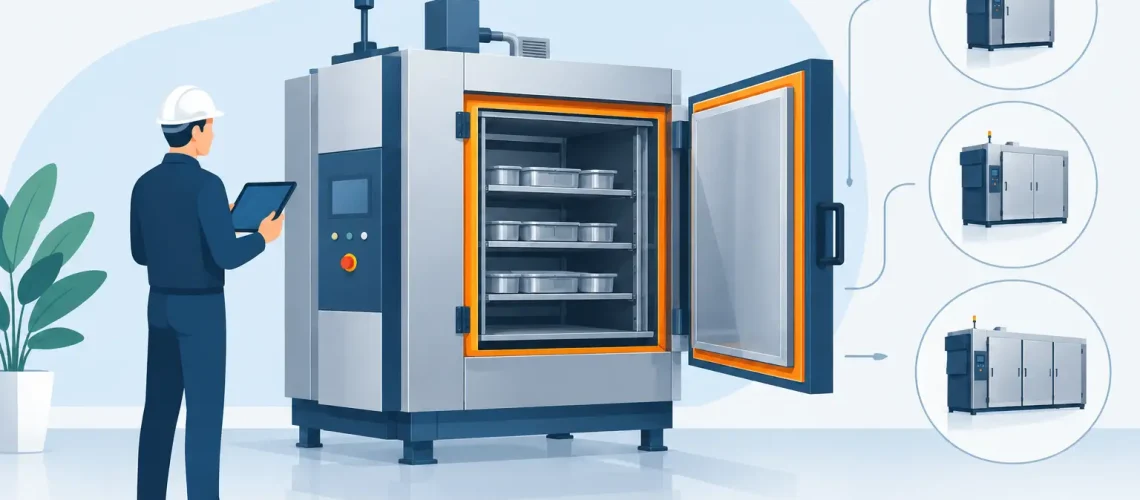
A curing oven that reaches temperature but creates uneven finishes is not doing its job. A dryer that slows the line, a furnace that consumes excessive power, or a sanitation unit that cannot match a facility’s workflow can create costs far beyond the equipment purchase price. Custom thermal processing equipment is designed to address those real operating conditions – not simply provide heat.
For manufacturers, healthcare facilities, food operations, and industrial laundries, the right system must fit the product, the available floor space, the required throughput, the safety controls, and the people who will operate it. That is why a purpose-built approach often delivers better long-term value than adapting a standard machine to a process it was never designed to handle.
Why Standard Thermal Equipment Can Fall Short
Off-the-shelf ovens, furnaces, dryers, and sterilization systems can be appropriate when a process is simple and production conditions are predictable. They may offer a shorter procurement cycle and a lower initial price. However, those advantages can disappear when the machine requires repeated adjustments, wastes energy through unnecessary capacity, or becomes a bottleneck as production changes.
Thermal processes are rarely defined by temperature alone. A coating line may require consistent air circulation to cure parts evenly. A washer-dryer operation may need trolley-compatible loading to reduce handling. A hygiene application may require controlled exposure time, reliable interlocks, and surfaces that support effective cleaning. In each case, the equipment needs to perform consistently across daily operating cycles, not only during a factory acceptance test.
Custom design allows the machinery to be built around these practical requirements. Dimensions can match the available production area. Loading and unloading can follow the existing material flow. Heating method, insulation, airflow, controls, and safety features can be selected for the actual duty cycle rather than a generic use case.
What Custom Thermal Processing Equipment Should Solve
A custom system should solve a defined process problem. Before design begins, the most useful conversations focus on what enters the machine, what must happen during the cycle, and what condition the product must reach before it moves to the next stage.
For an industrial oven, that may mean determining part size, coating type, cure profile, loading density, and required output per shift. For a furnace, the questions may center on operating temperature, heat-up rate, atmosphere, dwell time, and temperature uniformity. For dryers and sanitation equipment, moisture removal, hygiene requirements, handling methods, and turnaround time may be more relevant than peak temperature.
The following design elements typically have the greatest effect on performance:
- Chamber size and load configuration: Racks, trolleys, trays, conveyors, and fixtures must support safe loading while allowing heat and air to reach the work evenly.
- Heating and airflow design: Electric heating, recirculation fans, ducting, and air distribution affect temperature stability, drying speed, and product consistency.
- Control and monitoring: Electric control panels can provide programmable cycles, alarms, timers, sensor feedback, and operating records suited to the facility’s process needs.
- Safety and access: Door arrangements, insulation, emergency controls, interlocks, ventilation provisions, and service access should protect operators and simplify maintenance.
- Energy use and durability: Proper insulation, efficient heat management, and components selected for the duty cycle can reduce avoidable operating costs and extend service life.
Not every application needs every feature. A high-volume automotive curing line may justify automated material handling and detailed recipe control, while a hospital trolley sterilizer may prioritize straightforward operation, dependable cycle control, and easy cleaning. The right level of engineering depends on the risk, volume, and process tolerance of the application.
Consistency Is a Production Requirement
Temperature variation can show up as rejected parts, inconsistent coating adhesion, incomplete drying, excess cycle time, or uncertain sanitation results. These issues are often blamed on operators when the underlying cause is airflow imbalance, inadequate sensing, poor loading design, or a control system that does not reflect the actual process.
A well-engineered thermal machine considers the full thermal path. Heat must be generated efficiently, distributed where it is needed, retained within the chamber, and controlled throughout the cycle. Sensors and controls should support repeatability, while the physical machine must withstand the daily realities of loading, cleaning, vibration, and heat exposure.
This is especially relevant in facilities with mixed product sizes or changing production schedules. Equipment designed with adjustable racks, suitable access points, and adaptable control settings can accommodate variation without forcing the team to improvise workarounds.
From Process Review to Installation
The best custom equipment projects begin before a drawing is approved. A supplier should understand the site conditions as carefully as the thermal requirement. Ceiling height, electrical supply, ventilation, drainage, access routes, adjacent machinery, and operator movement all influence the final design.
A practical engineering process starts with a review of the product and workflow. The machine concept then defines capacity, chamber configuration, controls, heating approach, safety provisions, and installation requirements. Fabrication should follow approved specifications and quality checks, with testing performed before delivery where applicable.
Installation is not an afterthought. A machine may be well built yet underperform if utility connections, extraction, leveling, controls integration, or operator handover are incomplete. Commissioning should confirm that the equipment is installed correctly, that safety functions operate as intended, and that personnel understand normal operation and basic care.
REK Engineering Machinery approaches custom projects as an engineering and service responsibility, supplying equipment that can be supported through installation, maintenance, and technical assistance. This continuity matters because the people who understand the original design are better positioned to diagnose issues, advise on operating changes, and plan preventive service.
Selecting a Supplier for a Custom Build
Procurement teams should evaluate more than the quoted machine specification. A low purchase price can be misleading if the system has limited service access, uses unsuitable components, lacks documentation, or cannot be modified when the process changes.
Ask how the supplier validates temperature performance and controls. Ask who will manage installation and startup. Confirm the availability of maintenance support, replacement parts, and technical guidance after handover. For hygiene-sensitive environments, also ask how the design supports cleaning, safe operation, and the facility’s internal sanitation procedures.
It is equally useful to discuss the trade-offs openly. Faster heat-up may require greater installed power. A larger chamber may increase flexibility but also increase energy use if it regularly runs half empty. Highly automated controls can improve repeatability, but only if the facility has the training and maintenance practices to use them well. Good engineering makes those choices visible before fabrication begins.
Plan for Maintenance Before the First Cycle
Thermal equipment operates under demanding conditions. Fans, heating elements, sensors, seals, switches, wiring, insulation, and control components all need periodic inspection. Neglecting small issues can lead to temperature drift, longer cycles, higher power consumption, or unexpected downtime.
A maintenance plan should be based on the machine’s operating hours, process temperature, loading conditions, and cleaning environment. Operators can support reliability by keeping air paths clear, reporting unusual noise or heating behavior, checking door seals, and following the intended loading method. Scheduled technical service can then address calibration, electrical checks, component wear, and system performance before a production interruption occurs.
This is one of the practical advantages of working with an engineering partner rather than treating a custom machine as a one-time purchase. Process requirements may change, output may increase, and facilities may need controls updates or modifications over time. Equipment with a clear service path remains useful longer.
Build Around the Process, Not the Catalog
Custom thermal processing equipment is most valuable when it turns a difficult or inconsistent operation into a controlled, repeatable one. Whether the goal is curing coated components, drying washed materials, heating industrial parts, or supporting hygiene procedures, the machine should make the process safer, more efficient, and easier to manage.
The right next step is to define the operating challenge in practical terms: the product, the cycle, the output target, the site constraints, and the result that cannot be compromised. With those details on the table, an experienced engineering team can design equipment that earns its place on the production floor for years to come.