
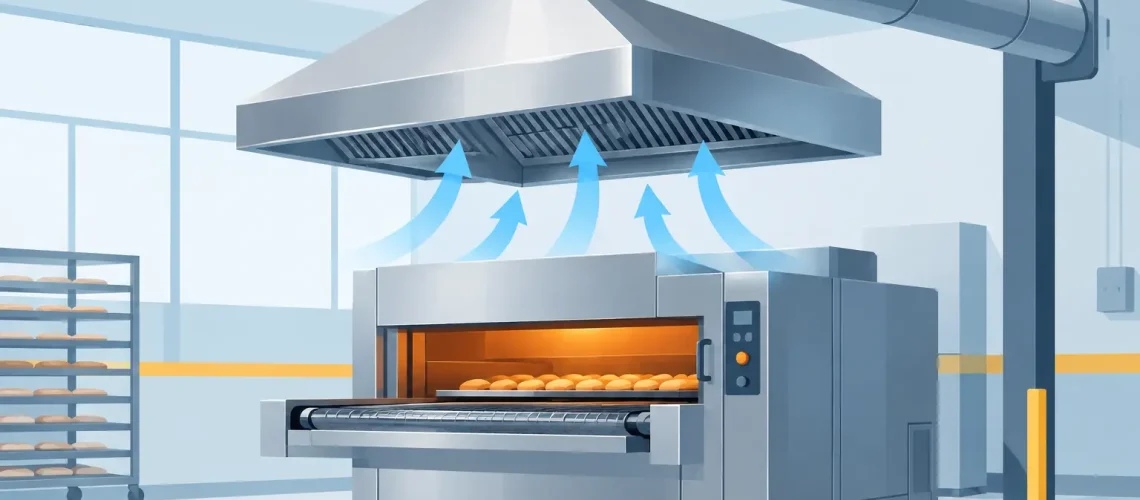
A curing oven that produces consistent parts can still create a facility risk if heated vapors, combustion products, or excess heat have nowhere controlled to go. Industrial oven ventilation requirements are therefore not an add-on to equipment selection. They are a core part of process safety, product quality, energy use, and long-term operating reliability.
The right system depends on what the oven heats, the materials carried into the chamber, the heat source, the production rate, and the applicable codes at the installation site. A small electric drying oven and a continuous gas-fired paint-curing line may both use heated air, but their ventilation needs can be fundamentally different.
Why ventilation is part of oven performance
Industrial ovens release more than heat. Depending on the process, the exhaust stream may contain moisture, powder, smoke, oil mist, cleaning chemical vapors, plasticizers, solvents, or products of combustion. If these contaminants remain in the chamber or escape into the work area, the result may be inconsistent curing, discoloration, poor coating adhesion, odor complaints, corrosion, unsafe vapor accumulation, or uncomfortable working conditions.
Ventilation also affects temperature control. Every cubic foot of air exhausted from an oven must be replaced by make-up air. If replacement air is uncontrolled, cold drafts can enter the production area, increase heating demand, and disturb the oven’s temperature uniformity. A system that simply extracts more air is not automatically safer or more efficient.
For facilities with flammable materials, proper exhaust is a first line of defense against vapor concentrations reaching an ignitable range. It must work together with temperature controls, airflow proving, purge logic, burner safeguards, interlocks, and disciplined operating procedures. No single component should carry the entire safety burden.
Industrial oven ventilation requirements: start with the process
The most useful design question is not, “How large should the exhaust fan be?” It is, “What can enter the oven, what can be generated inside it, and where should it be safely discharged?” Answering that question requires a process review before equipment fabrication or installation.
Identify the load and contaminants
Begin with the workpiece, coating, adhesive, oil, wash residue, packaging material, and rack or trolley entering the chamber. Water-based products can still release combustible or irritating constituents when heated. Components that appear dry may carry residual machining oil or cleaning agents. New product lines can change the vapor load substantially, so ventilation capacity should not be based only on the current production mix.
The material supplier’s safety data and the coating or solvent manufacturer’s technical documentation are essential inputs. They help determine whether vapors are combustible, corrosive, toxic, condensable, or likely to leave deposits in ducting. This information also guides decisions about fan construction, duct material, access doors, filtration, and discharge location.
Determine the oven heat source
Gas-fired ovens require ventilation for combustion products as well as process exhaust. Burner design, fuel input, combustion-air supply, flue arrangement, and safety shutoff sequences must be coordinated. An insufficient combustion-air path can lead to poor burner performance and create negative pressure problems in the room.
Electric ovens do not produce combustion gases, but they may still need process exhaust and room ventilation. In some low-emission drying applications, the main concern is heat rejection to the work area. In others, such as curing coated components or heating oily parts, vapor management remains the controlling issue.
Classify the hazard correctly
Where flammable solvents or vapors are involved, the installation should be evaluated against the relevant fire, mechanical, electrical, and occupational safety requirements enforced by the local authority having jurisdiction. In the United States, this commonly includes applicable provisions of NFPA standards, building and mechanical codes, fire code requirements, and OSHA expectations. Local rules, insurer requirements, and the specific process can impose additional conditions.
A qualified engineering review should establish whether the oven is handling flammable or combustible materials, the expected vapor generation rate, and the safeguards required. This is not an area for guessing based on another facility’s fan size.
Design the airflow as a controlled system
A ventilation system has several connected elements: oven openings, internal airflow paths, exhaust pickup points, fans, ductwork, discharge equipment, make-up air, controls, and room pressure. Weakness in one element can undermine the rest.
Exhaust where contaminants are generated
Exhaust pickup location should match the behavior of the contaminant. Heat and many vapors rise, but a large door opening, conveyor movement, cross-drafts, or a poorly positioned fan can pull fumes through the operator zone before they leave the room. For ovens with loading and unloading openings, canopy hoods, slot hoods, vestibules, or engineered capture points may be needed to control emissions at the source.
Internal oven circulation should be kept separate in concept from exhaust. Recirculation fans are designed to maintain temperature uniformity around the product. Exhaust fans remove a defined portion of chamber air. Changing the exhaust setting without considering recirculation, burner input, and control tuning can produce uneven temperatures or longer cycle times.
Provide make-up air deliberately
Exhaust without make-up air depressurizes a building. Doors become difficult to open, nearby exhaust systems perform poorly, and uncontrolled outdoor air enters through gaps. In extreme cases, negative building pressure can interfere with combustion equipment or draw contaminants from adjacent areas.
A properly designed make-up air system replaces exhausted air in a location and at a temperature that supports the process. It may be tempered, filtered, and distributed away from sensitive loading zones. The correct approach depends on climate, required room conditions, exhaust volume, and whether heat recovery is practical. Heat recovery can reduce energy costs, but it must never create a path for contaminated exhaust to re-enter supply air.
Size ductwork and fans for real resistance
Fan selection should account for more than target airflow. Duct length, elbows, transitions, dampers, hoods, filters, treatment equipment, roof penetrations, and discharge stacks all add static pressure. A fan that appears adequate on paper may underperform after installation if the duct route changes or filters load with residue.
Ducting should be designed for cleaning and inspection where deposits are possible. Long horizontal runs and sharp turns can become collection points for oils, powders, or condensable vapors. Accessible cleanouts, appropriate materials, secure supports, and a discharge point that prevents re-entry into the building are practical details with major consequences.
Use safety controls, not manual judgment alone
For processes involving potentially hazardous vapors, the exhaust system should be tied to the oven’s operating sequence. Airflow proving devices can confirm that the fan is operating before heat is enabled. Loss of required airflow should initiate an appropriate alarm and safe shutdown response. The exact logic should reflect the hazard assessment and applicable code requirements.
Purge cycles are also significant for certain ovens. Before ignition or heating begins, a controlled airflow sequence may be required to clear the chamber of accumulated vapors. The duration, airflow rate, and interlocking method must be engineered for the oven volume and process conditions, not treated as a generic timer setting.
Temperature limit controls, flame supervision for fuel-fired units, emergency stops, access-door interlocks where appropriate, and clearly labeled operating instructions complete the safety framework. Controls should be tested during commissioning and periodically thereafter. A fan motor that runs is not proof that the system is delivering the required airflow.
Consider the facility, not only the oven
An oven installation can affect nearby spray booths, washers, dust collection systems, HVAC equipment, and occupied work areas. A layout review should consider material flow, forklift routes, roof space, service access, noise, heat discharge, and future expansion. Exhaust discharged too close to an outside air intake can send odors or contaminants back into the building. Poorly planned roof penetrations can also make maintenance unnecessarily difficult.
For food, healthcare, laundry, and hygiene-sensitive operations, ventilation design must additionally support cleanliness. Duct leakage, condensate, and inaccessible areas can become maintenance concerns. Where sanitation is central to the process, equipment layout should make cleaning and verification straightforward rather than dependent on difficult workarounds.
Commission, document, and maintain the system
Ventilation performance should be verified after installation, not assumed from design drawings. Commissioning should confirm fan rotation, airflow direction, capture at openings, room pressure behavior, control interlocks, purge operation where required, temperature stability, and discharge performance. Baseline readings provide a reference for future maintenance.
Maintenance plans should include inspection of fan belts or drives, bearings, motors, dampers, sensors, filters, duct joints, roof terminations, and accumulated deposits. The right interval depends on operating hours and the material being processed. A clean drying application may need modest routine attention, while a coating or oil-heavy process may require frequent inspection.
Custom-built oven systems are most reliable when ventilation is designed alongside the chamber, controls, material handling, and facility services. Working with an engineering partner such as REK Engineering Machinery allows these decisions to be coordinated before installation, reducing costly changes after production has started.
A well-ventilated oven should not call attention to itself. It should hold stable process conditions, protect people and equipment, and give operators confidence that every production cycle can run as intended.