
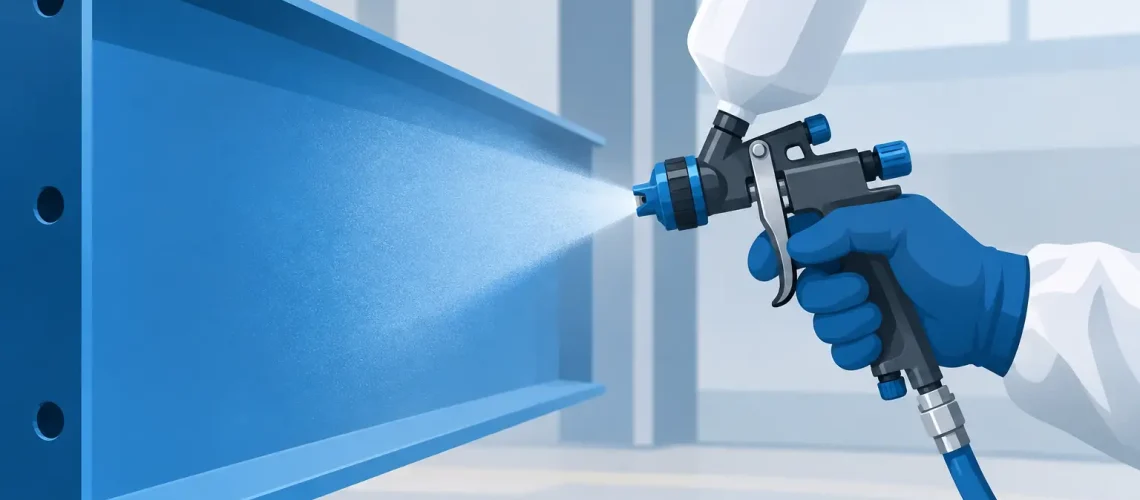
A coating line can appear productive while quietly losing money through overspray, uneven film build, rework, and frequent cleaning. In many facilities, the issue is not the coating material itself. It is the match between the material, the part geometry, the spray environment, and the industrial spray guns used to apply it.
For manufacturers coating metal parts, fabricated assemblies, machinery housings, cabinets, automotive components, or hygienic equipment, spray equipment is a process control tool. The right gun helps produce a repeatable finish with less material waste and less operator variation. The wrong gun can create defects that travel downstream into curing, inspection, assembly, and customer delivery.
Start With the Coating Process, Not the Gun
Selecting a spray gun by pressure rating or purchase price alone often creates problems later. The correct choice begins with the production requirement: what is being sprayed, onto which surface, at what production volume, and under what quality standard?
Coating viscosity has a direct effect on atomization. Thin solvents, stains, and low-viscosity coatings can atomize effectively with different fluid delivery and air settings than high-build primers, protective coatings, adhesives, or thick industrial finishes. A gun that performs well with one material may cause spitting, poor pattern control, or excessive air consumption with another.
Part shape matters as much as material. Flat panels can be coated efficiently with a wide fan pattern, while frames, corners, recessed areas, and tubular assemblies may require a narrower pattern or a more maneuverable gun. Facilities with frequent product changes may benefit from flexible manual equipment and quick-change setups. High-volume, repeatable work may justify automatic guns integrated into a conveyorized spray booth.
A practical evaluation should consider the required film thickness, acceptable finish quality, throughput target, coating cure method, operator skill level, and the available compressed-air capacity. These factors work together. Improving only one element rarely corrects a poorly balanced coating process.
Choosing Among Industrial Spray Gun Technologies
Industrial spray guns are commonly categorized by how they atomize and transfer coating material. Each approach has a place in industrial finishing, but no single technology is best for every line.
Conventional Air Spray
Conventional air spray guns use compressed air to break fluid into fine droplets. They can provide an attractive finish and precise pattern control, particularly where appearance is a primary requirement. The trade-off is that traditional high-pressure atomization can produce more overspray and lower transfer efficiency than other methods.
They remain useful when fine atomization is needed, but the facility must manage ventilation, filtration, material consumption, and operator technique carefully.
HVLP Spray Guns
High-volume, low-pressure, or HVLP, spray guns use a higher volume of air at lower pressure near the air cap. This can improve transfer efficiency by directing more material toward the component rather than into the booth exhaust system.
HVLP is often a strong option for operations seeking better material control and reduced overspray. However, it is not automatically the fastest solution. Some high-viscosity coatings may require careful setup, suitable fluid tips, and adequate airflow to maintain a stable pattern. An undersized air supply can leave the coating coarse or uneven.
LVMP and Compliant Spray Guns
Low-volume, medium-pressure and compliant spray gun designs aim to balance atomization quality with transfer efficiency. These systems can suit facilities that need a refined finish while working within environmental and material-use targets.
The real performance difference depends on the gun design, air cap, coating chemistry, pressure regulation, and technician setup. Labels alone should not make the purchasing decision. A test spray with the actual production coating and representative parts is far more useful.
Airless and Air-Assisted Airless Systems
Airless systems atomize coating through fluid pressure rather than compressed air at the cap. They are often used for higher-volume application, larger components, and thicker protective coatings. They can apply material quickly, though the finish may not suit every appearance-critical application.
Air-assisted airless equipment combines fluid pressure with air assistance to improve atomization. It can be effective where facilities need production speed, higher film builds, and a more controlled finish than a purely airless process can provide. The right choice depends on finish expectations and the coating supplier’s application recommendations.
The Gun Is Only One Part of the System
Even high-quality industrial spray guns cannot compensate for unstable air supply, poor filtration, incorrect hose sizing, or an unsuitable booth. Finishing quality is determined by the complete application system.
Compressed air should be clean, dry, and regulated consistently. Water or oil contamination can cause fish eyes, cratering, adhesion failures, and costly rework. Pressure drops through long hoses, undersized fittings, or poorly maintained filters can change the spray pattern during a shift. What looks like an operator issue may actually be an air-delivery issue.
Fluid handling also deserves attention. Coatings should be mixed according to the manufacturer’s instructions, filtered when appropriate, and kept within the required viscosity range. For two-component materials, pot life must be managed closely. A gun that clogs repeatedly may be signaling cured material in the fluid path, incorrect cleaning practice, or a fluid tip that is too small for the product.
The booth supports quality and safety at the same time. Adequate airflow captures overspray and helps keep the work area cleaner. Proper lighting allows operators to identify dry spray, missed edges, runs, and inconsistent coverage before parts leave the booth. For curing operations, the spray process should be coordinated with oven capacity and cure requirements so coated parts are not rushed, contaminated, or held beyond the material’s recommended window.
Setup Decisions That Affect Every Coated Part
Correct setup is not a one-time task performed during installation. It should be treated as a controlled operating procedure, especially when coatings, colors, part sizes, or operators change.
Begin with the recommended fluid tip and air cap for the material. A tip that is too small restricts flow and can encourage operators to increase pressure unnecessarily. A tip that is too large can make material delivery difficult to control, increasing the risk of runs and excess film build.
Set fluid flow before increasing air pressure. Then adjust the fan pattern to cover the part efficiently without sending excessive material beyond its edges. Test panels are useful, but representative production parts are better because edges, angles, and recesses expose setup limitations quickly.
Spray distance, gun angle, and overlap also matter. Holding the gun too far away can cause dry spray and wasted material. Spraying too close may create runs or an overly wet film. Operators should keep the gun perpendicular to the surface where possible and use consistent passes. Training is not merely a quality initiative – it directly supports material control, predictable cure results, and safer booth operation.
Maintenance Protects Transfer Efficiency and Uptime
A spray gun is a precision device operating in a demanding environment. Dried coating on the air cap, damaged needles, worn packings, and blocked passages can change atomization long before a complete failure occurs.
Daily cleaning should remove coating from the air cap, fluid tip, and exterior without damaging precision openings. Avoid using hard wire or inappropriate tools to clean air cap holes, as altered passages can distort the fan pattern. Follow the coating manufacturer’s cleaning guidance and use compatible cleaning materials.
A planned maintenance routine should include inspection of needles, nozzles, seals, hoses, regulators, filters, and grounding arrangements. Keep wear parts available for equipment that supports production-critical operations. Waiting for a small leak or poor pattern to become a line stoppage is rarely cost-effective.
For facilities with several booths or mixed coating processes, standardizing equipment where practical can simplify spare-part inventory, technician training, and troubleshooting. Customization still has a role. A specialized material or difficult part geometry may require a dedicated setup rather than a standardized one.
Safety, Compliance, and Energy Use
Spray application involves airborne particles, chemicals, pressurized equipment, and, in some processes, flammable materials. Equipment selection must align with the coating’s safety data, the booth design, ventilation requirements, electrical classification, and applicable local regulations.
Operators need suitable personal protective equipment and clear procedures for spraying, cleaning, flushing, and responding to leaks. Grounding is especially important where static charge could create a hazard or affect coating deposition. Maintenance teams should isolate energy sources before servicing pressurized fluid and air systems.
Efficiency is also a sustainability issue. Better transfer efficiency can reduce coating consumption, booth loading, cleaning demand, and disposal volumes. Reducing waste does not mean sacrificing coverage. It means designing the process so material is directed to the component with fewer corrective passes.
REK Engineering Machinery approaches spray equipment as part of a complete finishing operation, with the booth, airflow, controls, curing equipment, and maintenance plan considered together. That engineering perspective is particularly valuable when an off-the-shelf configuration does not fit the actual workflow.
The most useful next step is often a process review on the production floor: observe the parts, coating, defects, throughput, and existing utilities before specifying equipment. A spray gun should support the way your facility needs to work, not force your operation to adapt around it.