
A curing oven that reaches temperature but cannot hold its recipe is not delivering a controlled process. A washer that stops because of a nuisance trip can disrupt an entire hygiene cycle. In both cases, the machinery may be mechanically sound, but its electrical controls are not properly aligned with the work. An electric control panel design service turns operating requirements into a safe, maintainable control system that gives equipment the right sequence, protection, visibility, and response.
For plant managers and project teams, the panel should never be treated as an accessory added after the machine is designed. It is the operating center for motors, heaters, sensors, safety devices, and production logic. The right design supports repeatable output. The wrong one creates avoidable downtime, difficult troubleshooting, excess energy use, and higher exposure to electrical or process-related risk.
What a custom control panel must solve
An industrial control panel has to do more than distribute power. It must coordinate what happens when the machine starts, runs, pauses, alarms, and shuts down. For thermal processing equipment, that may include staged heater control, air circulation, temperature feedback, over-temperature protection, and timed recipes. For sanitation or washing systems, it may involve pump sequencing, water levels, dosing, interlocks, and cycle confirmation.
That is why a useful design process starts with the application rather than a cabinet size or a preferred component list. The engineering team needs to understand the product being processed, the required throughput, the operator workflow, available utility supply, environmental conditions, and the consequences of a process interruption. A batch oven used for powder coating has different control priorities than a trolley sterilizer in a hospital or a parts washer on an automotive line.
The panel also needs to account for the equipment around it. A design that works on a standalone machine may need a different architecture when it communicates with conveyors, extraction systems, building alarms, or a plant supervisory system. A clear scope at the beginning prevents costly changes after fabrication and installation.
Electric control panel design service for real operations
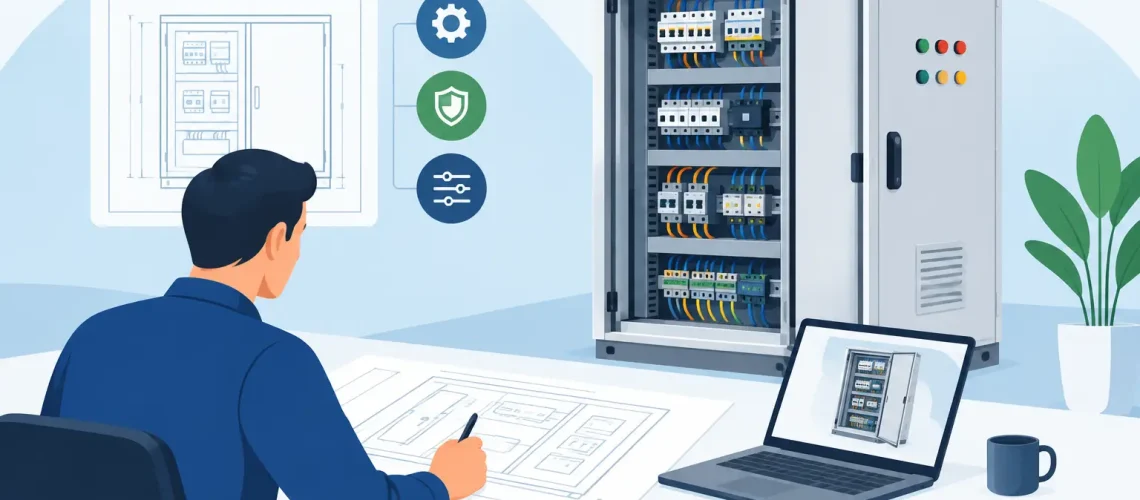
A dependable electric control panel design service begins by converting the operating sequence into documented engineering decisions. This normally includes electrical schematics, component selection, panel layout, wire and terminal identification, I/O allocation, control logic, and testing requirements. These documents make the panel easier to inspect before shipment and easier to service years later.
Component selection should match actual duty, not only the lowest initial purchase price. Contactors, overload protection, variable frequency drives, power supplies, circuit breakers, relays, temperature controllers, PLCs, and enclosure cooling all affect long-term performance. A compact panel may appear efficient on paper, but limited spacing can trap heat, complicate wiring, and extend maintenance time. More capacity and physical space can cost more upfront while providing a better service life.
The same principle applies to controls architecture. A basic relay system can be a sensible choice for a simple machine with fixed functions and limited sensors. A PLC-based system is often more suitable when the process requires recipes, multiple operating modes, alarm history, communication, or future expansion. Neither approach is automatically better. The right choice depends on process complexity, operator needs, spare-parts strategy, and the facility’s ability to maintain the system.
For facilities with washdown, heat, dust, chemicals, or outdoor exposure, enclosure selection is equally critical. The enclosure material, sealing, ventilation, cable entry method, and component placement should suit the surrounding conditions. A panel installed beside a high-temperature furnace or in a humid wash area must be designed differently from one placed in a clean electrical room.
Safety must be designed into the sequence
Electrical safety is not limited to fitting an emergency stop button on the panel door. The control design must define what happens after the button is pressed, how motion and heat are brought to a safe state, which functions require a manual reset, and whether a restart is permitted after power returns. These decisions should reflect the machine’s hazards and the site’s operating procedures.
Safety interlocks are especially valuable in equipment involving heat, moving trolleys, pumps, blowers, doors, or chemical dosing. A door switch may prevent a heating cycle from starting while access is open. An airflow proving device can prevent heaters from energizing without circulation. High-limit temperature protection can act independently when the main controller fails to regulate as expected. These measures protect people, products, and equipment, but only when they are correctly selected, wired, tested, and maintained.
Compliance requirements vary by application, customer specification, installation location, and market. A control panel design should therefore be reviewed against the applicable electrical codes, machine safety expectations, and documentation requirements before fabrication. For US installations, project teams may need to consider requirements from the authority having jurisdiction, along with customer standards for labeling, short-circuit ratings, disconnects, and panel construction. Early review is more practical than reworking a completed panel after inspection.
Better controls improve process consistency
The strongest business case for a tailored panel is usually process control. When operators can see the right information and use controls that match their workflow, they spend less time interpreting inconsistent machine behavior. Clear status lights, readable alarms, defined setpoints, and logical screen layouts help operators act quickly without bypassing safeguards.
For thermal equipment, accurate sensor placement and control tuning matter as much as the controller itself. A temperature reading taken in the wrong location may show an acceptable value while the product zone remains uneven. Multiple zones, circulation control, staged heating, and recipe management may be justified when load variation or product quality requirements are high. For lower-volume operations, a simpler approach may be more appropriate if it can still provide reliable temperature control and traceable operating records.
Energy performance also deserves attention. Variable speed control for fans and pumps, timed standby modes, load-based heater staging, and clear operating schedules can reduce unnecessary consumption. These measures should not compromise airflow, wash quality, or temperature recovery. Engineering should test the full process, because an energy-saving setting that lengthens cycle time or creates rejects may increase total operating cost.
Design for technicians, not just commissioning day
A panel can look organized during factory acceptance testing and still be difficult to maintain in the field. Serviceability depends on practical details: labeled wires and terminals, accessible components, current schematics, adequate cable routing, spare capacity, and sensible separation between power and control wiring. When a fault occurs during a busy shift, technicians need to identify the circuit quickly and replace common parts without dismantling half the cabinet.
Remote monitoring can provide useful support for selected applications. It may allow authorized personnel to review alarms, operating status, or trends before arriving on site. However, remote access should be planned carefully with the facility’s cybersecurity rules, network availability, and access-control policies. It is a support tool, not a replacement for safe local controls and trained maintenance personnel.
Commissioning is where the design is proven against the actual machine. Each input, output, alarm, interlock, motor direction, heater stage, and operating mode should be checked under controlled conditions. The team should also confirm recovery after power loss, sensor fault behavior, emergency-stop response, and normal operator procedures. A thorough handover includes drawings, operating guidance, maintenance recommendations, and a clear path for technical support.
Choose an engineering partner that stays accountable
The best panel supplier asks detailed questions before proposing a solution. They should be prepared to discuss the process, duty cycle, environmental conditions, future capacity, maintenance expectations, and site interfaces. They should also explain trade-offs plainly, including where a standard panel is sufficient and where custom engineering will protect uptime or product quality.
REK Engineering Machinery approaches controls as part of the complete equipment solution, from custom machinery fabrication and installation through maintenance and technical support. That integrated perspective is valuable when the panel must coordinate ovens, furnaces, washers, dryers, sterilizers, spray systems, or other specialized industrial equipment.
A well-designed panel gives a facility more than switches and indicators. It gives operators a clearer process, technicians a manageable system, and decision-makers a stronger foundation for reliable production. Start with the operating problem that needs to be solved, then build the control panel around the people, process, and equipment that depend on it.