
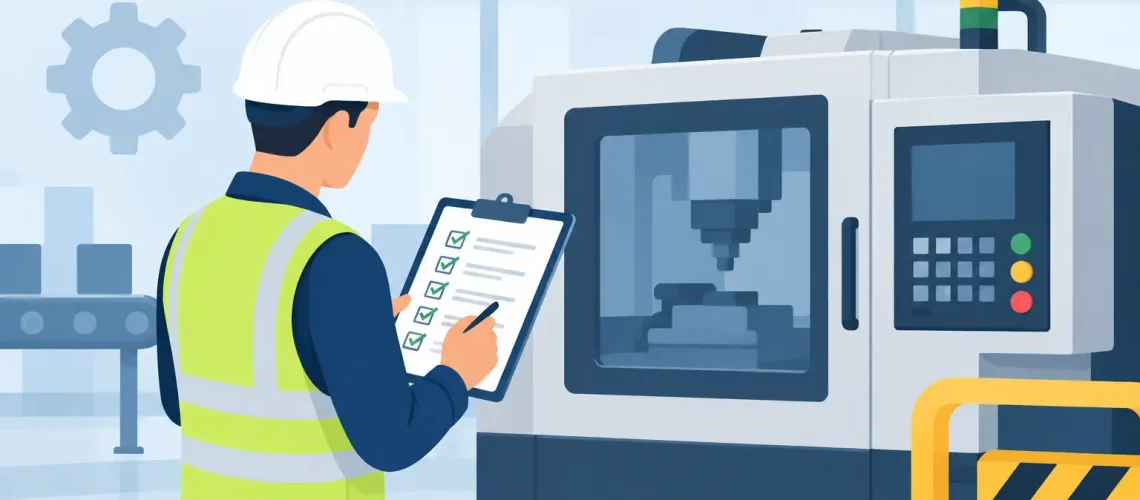
A new industrial oven, washer, sterilizer, dryer, spray booth, or custom-built process machine should not move straight from installation to full production. A disciplined machine commissioning checklist creates the controlled handover between construction and operation. It confirms that the equipment is safe, connected correctly, performs to specification, and can be operated and maintained by the people responsible for it.
For plant managers and engineering teams, commissioning is not paperwork added after the work is done. It is the point at which design assumptions meet real site conditions: actual utilities, product loads, operator routines, ventilation performance, and production demands. Catching a fault here is far less costly than discovering it during a shift, after a safety incident, or when product quality has already been affected.
Why commissioning determines long-term machine performance
Industrial machinery can appear complete while still being unready for operation. A control panel may power up, but an incorrectly labeled sensor, unsuitable exhaust balance, loose terminal, wrong rotation direction, or incomplete interlock test can create downtime later. For thermal processing and hygiene equipment, small deviations can also affect temperature uniformity, drying results, sanitation outcomes, energy consumption, and batch consistency.
Commissioning gives the owner, installer, and operator a shared factual record. It establishes the accepted operating condition of the machine and identifies any remaining actions before production responsibility is handed over. This record is particularly valuable for customized equipment, where the machine has been designed around a specific process rather than selected from a standard catalog.
The depth of commissioning depends on the machine and its risk profile. A simple standalone dryer requires a different validation process than a conveyorized curing oven, hospital trolley sterilizer, multi-stage washer, or integrated spray booth. However, the same principle applies: verify each system deliberately, document the result, and do not treat production output as proof that the installation is correct.
Machine commissioning checklist: what to verify before startup
A practical checklist should follow the order in which the equipment is made ready: documentation, physical installation, utilities, safety, controls, process performance, and personnel readiness. The checklist should identify who completed each test, when it was completed, the measured result, and any corrective action required.
Confirm documentation and installation scope
Start by checking that the delivered equipment matches the approved scope. Verify the machine model, serial number, installed options, layout orientation, guarding arrangement, and accessories against the approved drawings or purchase specification. If the process requires particular materials, finishes, filtration, heating capacity, or automation functions, confirm these before functional testing begins.
The site file should include operating instructions, electrical drawings, pneumatic or hydraulic diagrams where applicable, recommended maintenance tasks, spare-parts information, and calibration records for supplied instruments. For custom machinery, retain the final approved process parameters and design assumptions. These details provide a baseline if the facility later changes products, throughput, or operating hours.
Inspect the physical installation as well. The machine should be level where required, securely anchored, accessible for maintenance, and positioned with adequate clearance for loading, unloading, cleaning, and emergency access. Ducting, drain lines, cable routes, and service connections should be supported properly and protected from likely mechanical damage.
Verify electrical, utility, and environmental connections
Utilities are often the source of commissioning delays because available site conditions can differ from the original project data. Confirm incoming voltage, phase, frequency, grounding, circuit protection, and cable sizing against the machine requirements. Electrical work should be inspected by qualified personnel before energization, especially where high-current heating loads, variable-speed drives, or integrated control panels are involved.
Verify compressed air pressure and quality, water supply pressure, drainage capacity, gas supply where relevant, and steam or thermal oil services if used. Check every connection for leaks and confirm that isolation valves, regulators, filters, and gauges are accessible and correctly identified.
For ovens, furnaces, dryers, and spray booths, environmental controls need equal attention. Confirm that exhaust airflow, make-up air, ventilation paths, and discharge arrangements meet the equipment design and the facility’s safety requirements. Excessive negative pressure can affect heating efficiency and door operation; inadequate extraction can create an unsafe or uncomfortable work area. The right setting depends on the process, the material being handled, and the local installation conditions.
Test guards, interlocks, and emergency functions
Safety devices must be tested under realistic operating conditions, not merely inspected visually. Check emergency-stop devices, door and access interlocks, thermal cut-outs, over-temperature protection, pressure relief devices, alarms, light curtains, guards, and lockout points as applicable to the machine.
Document both the expected response and the actual response. For example, opening an interlocked oven door may need to stop a conveyor, disable heating, activate an alarm, or follow a programmed cool-down sequence. The correct response is determined by the equipment design and risk assessment. A safety device that stops the machine but leaves a hazardous energy source active is not a completed test.
Also inspect labels and operator warnings. Labels should be durable, visible, and understandable to the people using the equipment. Mark electrical isolation points, hot surfaces, pinch points, chemical hazards, and required personal protective equipment clearly. If the machine serves a multilingual workforce, site-specific visual instructions may be appropriate.
Validate controls and operating sequences
Control validation confirms that the machine does what the approved process requires. Test start, stop, reset, manual controls, automatic sequences, timers, temperature controllers, sensors, alarms, recipes, variable-speed drives, and any interface with upstream or downstream equipment.
Check sensor readings against calibrated reference instruments where process accuracy matters. For a thermal system, compare displayed temperatures with independent measurements at representative points in the working zone. For washers and sterilization equipment, verify cycle stages, water temperatures, chemical dosing where applicable, rinse functions, and final cycle completion signals.
Do not limit testing to an empty machine. Run representative loads, products, racks, trolleys, or fixtures. An oven that reaches setpoint when empty may perform differently with a full production load. A washer may drain correctly without parts but struggle when filters collect process debris. Testing with realistic loads reveals whether airflow, heating capacity, handling arrangements, and cycle times are suitable for daily operation.
Establish acceptable performance results
A commissioning plan should define what acceptance looks like before testing starts. This may include temperature range, heat-up time, cure time, drying result, throughput, energy use, cycle repeatability, wash quality, noise level, or control accuracy. Where hygiene is central to the application, acceptance criteria may include cleaning coverage, final rinse temperature, sterilization cycle records, or contamination-control procedures.
Record deviations without trying to explain them away. A machine may still be safe to operate while requiring adjustment to meet its intended production target. Separating safety-critical issues from performance optimization helps teams set the right priority. Safety faults should be corrected before release. Process refinements may be completed during an agreed monitored period, provided they do not compromise safe operation or product requirements.
Prepare operators and maintenance teams for handover
A machine is only commissioned when the people who run it understand its normal operation and its limits. Training should cover startup and shutdown, loading practices, routine cleaning, parameter selection, alarm response, emergency procedures, and daily inspections. Operators should know which adjustments they are authorized to make and when to call engineering or service support.
Maintenance personnel need a different level of detail. They should understand isolation procedures, lubrication points, wear components, filter changes, calibration needs, recommended inspection intervals, and common fault indicators. Establishing this routine early reduces avoidable breakdowns and protects the machine’s performance over time.
At REK Engineering Machinery, commissioning support is treated as part of the equipment lifecycle, not the final installation task. Clear site acceptance records, practical operator guidance, and planned maintenance give facilities a stronger foundation for dependable operation.
Release the machine only with clear ownership
Before final sign-off, close open items or assign each one to a named owner with a due date. Keep the completed checklist, test results, photographs where useful, and training records in the facility’s equipment file. Review the machine after its first period of production, when real throughput and operator feedback can reveal improvements that were not visible during initial tests.
A well-commissioned machine starts its working life with known conditions, trained operators, and a documented standard to maintain. That gives your team a practical reference whenever production changes, service is required, or the next custom engineering decision needs to be made.