
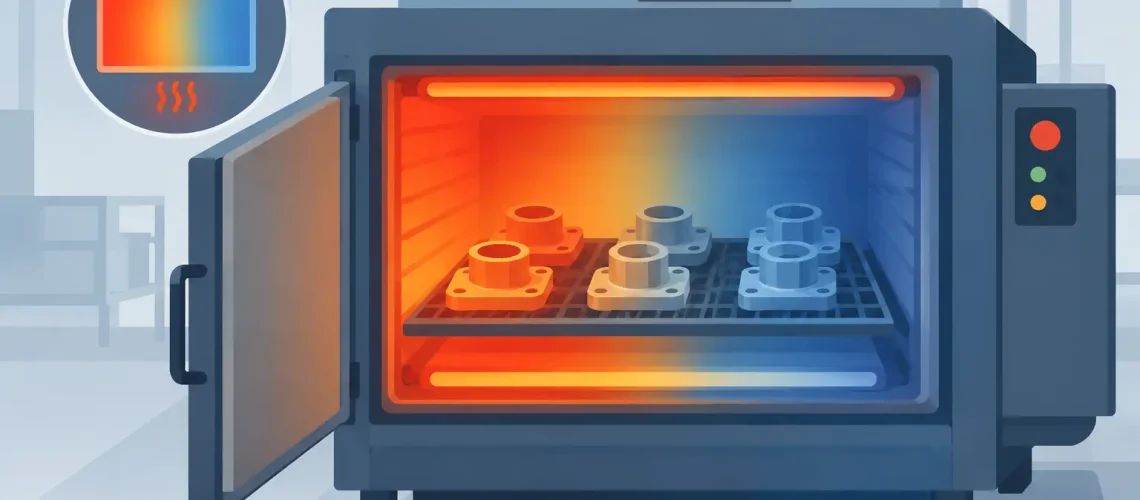
A batch of coated parts exits the oven with one side fully cured and another still tacky. A dryer produces acceptable results on the top trolley but leaves moisture in the lower racks. In a sterilization process, a cold spot can be more than a quality issue – it can compromise hygiene validation and create a serious operational risk. These are the practical consequences behind the question, what causes uneven heating.
In industrial thermal equipment, heat uniformity is not created by the heater alone. It depends on the relationship between air movement, chamber design, product loading, controls, insulation, and maintenance. A higher setpoint may appear to solve a cold-zone problem, but it often overheats the fastest-heating areas while leaving the actual cause untouched. The better approach is to identify where the temperature difference begins and what is preventing heat from reaching the load consistently.
What Causes Uneven Heating in an Industrial Oven?
Uneven heating occurs when different areas of the chamber, or different locations within a product load, do not reach and hold the required temperature within the allowable process tolerance. The result may be uneven curing, incomplete drying, inconsistent bonding, material distortion, excess energy use, or failed sanitation performance.
Some temperature variation is normal. Every industrial process has a specified tolerance based on the material, product geometry, cycle time, and quality requirement. The concern begins when the variation exceeds that tolerance or changes unpredictably from one batch to the next. A powder-coating line may require tight control to achieve a durable finish, while a preheating operation may permit a wider range. The acceptable limit depends on the process, not a single universal number.
Poor airflow distribution
Airflow is the most common source of uneven heating in forced-convection ovens, dryers, and many curing systems. Heated air must travel through the chamber, around the load, and back to the circulation system. If air follows the easiest route instead of passing through the product, some zones receive more heat than others.
Blocked supply ducts, damaged baffles, poorly positioned return-air openings, or low fan performance can all create hot and cold areas. Fan rotation direction also matters. A fan that is installed incorrectly after service can move air with sufficient volume but in the wrong pattern for the chamber design.
Airflow problems are especially visible with dense racks, stacked trays, textile loads, parts in deep baskets, and products with enclosed cavities. The chamber sensor may show the correct temperature while the center of the load remains below target because the heated air never reaches it effectively.
Incorrect loading and product arrangement
An oven can be well designed and still perform poorly when overloaded or loaded inconsistently. Products placed too close together restrict airflow. Large items placed directly in front of supply openings can shield smaller parts behind them. Solid trays, tightly packed cartons, and tall trolleys can act as barriers that divide the chamber into separate temperature zones.
Load mass matters as much as load spacing. A heavy steel component absorbs heat slowly, while a light aluminum part responds quickly. When both are processed in the same cycle, the light part may reach temperature long before the heavier component. If the recipe is based only on air temperature and elapsed time, the true product temperature can vary significantly.
A practical loading pattern leaves defined air paths around, above, and below the product. It also keeps rack placement repeatable. When every operator loads the equipment differently, process consistency becomes difficult to verify, even with accurate controls.
Heater, burner, or electrical supply faults
A heating system that cannot provide balanced output will create inconsistent chamber conditions. In electric ovens, failed heating elements, uneven element aging, loose terminals, incorrect phase balance, or damaged contactors can reduce heat on one side or one zone. In gas-fired systems, burner tuning, fuel pressure, ignition reliability, and heat-exchanger condition can affect output and recovery time.
Partial heater failure is sometimes missed because the oven still reaches its setpoint during a lightly loaded cycle. Under a full production load, however, it may recover too slowly or show wider variation between zones. Monitoring heater current, power demand, burner operation, and heat-up time provides useful evidence before a failure becomes a production stoppage.
Control, sensor, and calibration issues
The control system can only respond to the information it receives. If a temperature sensor is located near a hot air supply, it may report the target temperature while the far end of the chamber remains cooler. A sensor that has drifted out of calibration can produce a similar problem, particularly in equipment that runs high-temperature or frequent cycles.
Poorly tuned PID settings may cause temperature overshoot and cycling. This is not always visible on a simple display because the displayed temperature may be averaged or filtered. Data logging at multiple points in the chamber is more revealing. It shows whether the equipment is stable, whether it overshoots after heat demand changes, and whether specific zones lag during recovery.
For critical curing, drying, or sterilization work, chamber temperature is only part of the picture. Product probes or representative load sensors may be necessary to confirm that the product itself reaches the required time and temperature condition.
Heat loss through doors, seals, and insulation
Damaged door gaskets, poor latch adjustment, warped doors, and worn insulation allow heat to escape and draw cooler ambient air into the chamber. The effect is often strongest near the door, but air circulation can carry that cooler air farther into the load.
Insulation deterioration can be gradual. Operators may compensate by raising the setpoint or extending cycle times, which increases energy consumption without restoring true uniformity. Exterior hot spots on the oven casing, unusually warm door frames, and longer warm-up times are useful warning signs. A physical inspection should confirm the condition of panels, seals, insulation, and access openings.
Process changes outside the oven
Not every heating issue originates inside the machine. Changes in incoming product temperature, moisture content, coating thickness, material grade, part color, or batch size can alter how the load absorbs heat. A cold load brought in from an unconditioned storage area will behave differently from one that has remained at room temperature.
Ambient conditions also matter. Drafts from open doors, extraction systems, or nearby cooling equipment can affect equipment with frequent door openings or weak seals. For processes involving evaporation, such as washing and drying, inadequate exhaust can raise humidity inside the chamber and slow drying even when the air temperature appears correct.
How to Diagnose the Source of Uneven Heating
Start with evidence rather than assumptions. Record the setpoint, actual temperature trend, load type, rack position, cycle time, door-opening frequency, and recent maintenance history. If the issue occurs only with a particular product or trolley arrangement, loading and heat transfer are more likely than a general heater fault.
A temperature-uniformity survey is the most reliable diagnostic method. Place calibrated sensors at representative chamber locations and, where appropriate, inside representative products. Run the equipment through a normal loaded cycle, not only an empty-chamber test. An empty oven may look uniform while a production load exposes restricted airflow and inadequate heat capacity.
The pattern of results offers direction. A consistently cool area near the door suggests leakage or insulation concerns. A cool center with hotter outer positions often indicates airflow restriction or an excessively dense load. Wide temperature swings throughout the chamber may point to control tuning, sensor placement, or heating-stage issues. A qualified engineering review can connect those observations to the equipment layout and process requirement.
Corrective Actions That Protect Process Consistency
The right correction depends on the root cause. Cleaning ducts and fans may restore circulation in one case; redesigning racking or adding baffles may be necessary in another. Increasing fan speed can improve heat transfer, but excessive air velocity may disturb lightweight products, damage a wet coating, or increase energy use. More heater capacity may shorten recovery time, but it cannot compensate for poor air distribution.
For recurring problems, standardize the loading method and document the approved rack configuration. Establish preventive maintenance for fan assemblies, belts, filters, gaskets, electrical connections, sensors, and insulation. Calibrate instruments on a defined schedule, and verify performance after major repairs or process changes.
When a process has tight quality or hygiene requirements, custom chamber zoning, airflow design, trolley configuration, and control logic may be justified. REK Engineering Machinery approaches these requirements as an integrated system because reliable thermal performance depends on how the machine and the operating workflow work together.
A stable process is built through repeatable evidence: the same load pattern, verified temperature data, maintained airflow, and controls that reflect actual product conditions. When those elements are aligned, heating equipment becomes easier to operate, easier to validate, and far more dependable over its service life.