A component can look clean and still cause a production problem. Residual oil can interfere with coating adhesion, fine swarf can damage a precision assembly, and cleaning fluid left in a cavity can compromise the next process. An industrial parts washer machine gives manufacturers control over this critical step, replacing inconsistent manual washing with a repeatable cleaning process designed around the part, contaminant, and production volume.
For plant managers and engineering teams, the decision is not simply whether to automate cleaning. It is whether the washer will consistently deliver the required cleanliness without creating unnecessary water use, chemical exposure, handling time, or maintenance burden. The right machine supports quality across the line. The wrong one becomes a bottleneck between machining, finishing, assembly, and inspection.
What an Industrial Parts Washer Machine Must Do
Industrial washing equipment removes process contaminants before they create downstream defects. Depending on the application, those contaminants may include machining oils, cutting fluids, grease, polishing compound, carbon deposits, dust, metal chips, fingerprints, or residue from previous production stages.
The required outcome differs by industry. An automotive supplier may need parts ready for painting or assembly. An aerospace operation may require controlled cleaning of complex components before inspection. A food processing facility may need washable tools, trays, and removable equipment parts to meet hygiene procedures. Electronics and medical applications may demand lower residue levels and carefully selected cleaning chemistry.
This is why a machine should be specified by cleaning result, not by tank size alone. A large washer with insufficient spray pressure, poor nozzle coverage, or unsuitable detergent can leave contamination in threads, blind holes, internal passages, and recessed surfaces. Conversely, an overly aggressive process can damage sensitive finishes or drive up operating cost without improving the result.
Start With the Parts and the Contaminant
The most useful first step is to document what enters the wash cycle and what must leave it. This gives equipment suppliers the information needed to design a workable process rather than propose a generic cabinet.
Part dimensions and weight determine the chamber size, loading method, basket construction, and whether a trolley, crane, or automated conveyor is required. Part geometry matters just as much. Deep cavities, cross-drilled holes, and tightly packed assemblies require targeted nozzle placement and reliable drainage. If water pools inside the part, drying time and corrosion risk can increase.
The contaminant determines the wash media, temperature, filtration approach, and cycle duration. Water-based alkaline detergents are commonly used for oils and general industrial soils, while other applications may require neutral chemistry, corrosion inhibitors, or a rinse stage. Heavy chips and sludge may call for staged filtration or a settling arrangement that protects pumps and nozzles.
Material compatibility must be assessed early. Aluminum, copper alloys, coated surfaces, plastics, seals, and painted components can react differently to heat and cleaning chemicals. A process that works well for steel transmission parts may not be appropriate for anodized aluminum assemblies.
Match the Washer Design to the Workflow
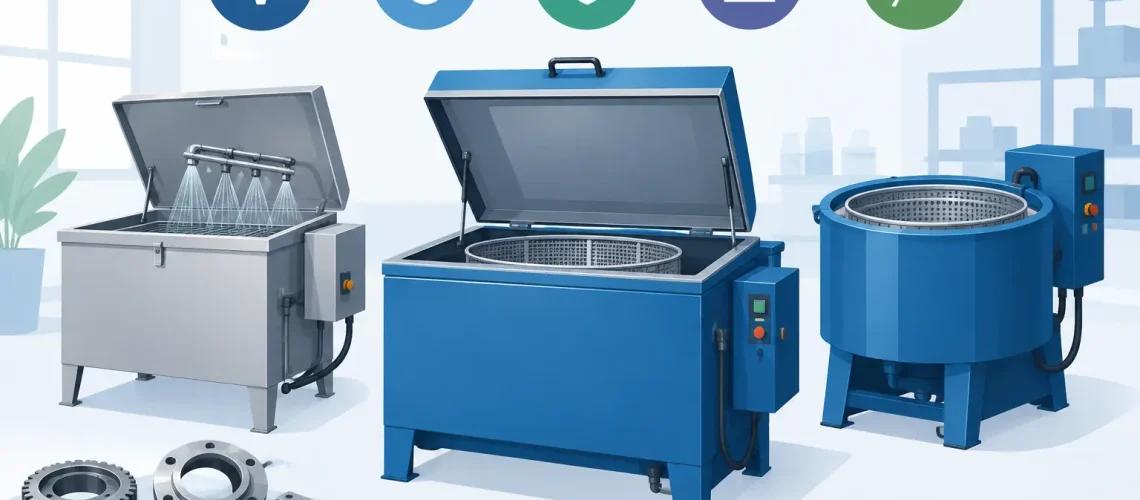
A manually loaded cabinet washer can be an efficient choice for low-to-medium volumes, maintenance departments, and mixed part sizes. The operator loads the components, selects a controlled cycle, and removes them after washing. This format reduces manual chemical handling and provides a contained cleaning area.
For repetitive production, a conveyor or tunnel system may be more suitable. Parts move through defined wash, rinse, blow-off, and drying zones, allowing cleaning to match takt time. The investment is higher, but the gain can be significant where manual loading slows output or where every component must receive the same treatment.
Rotary basket systems are practical for batches of smaller components, provided the parts can move or tumble without damage. Spray systems work well when parts need direct impingement from multiple angles. Immersion stages may be beneficial for intricate shapes, although they require disciplined bath management to prevent contaminants from being carried from one batch to the next.
The best design often combines methods. A custom system may use heated spray washing for bulk soil removal, a fresh-water rinse to reduce detergent residue, and heated air drying before parts move to assembly or coating. The correct sequence depends on the process requirement, available floor space, utility capacity, and target cycle time.
Cleaning Performance Depends on More Than Pressure
High pressure alone does not guarantee clean parts. Effective washing comes from the relationship between time, temperature, chemistry, mechanical action, and coverage. Changing one variable may reduce the need for another, but there are limits.
Higher temperatures can improve oil removal and shorten drying time, yet they also increase energy demand and may affect heat-sensitive materials. Stronger chemical concentration may remove stubborn soils faster, but excessive concentration can raise operating costs, increase corrosion risk, and complicate wastewater treatment. Longer cycles can improve cleaning, but may reduce line capacity.
Nozzle arrangement is frequently underestimated. The spray pattern must reach critical surfaces while the workpiece is positioned so that contaminants and wash solution can drain away. A well-engineered fixture can make a standard wash cycle effective. Without it, even a capable machine may produce inconsistent results.
For this reason, cleaning trials using representative parts are valuable before finalizing a specification. They allow the team to evaluate cleanliness, drying quality, surface appearance, cycle time, and ease of loading under realistic conditions.
Consider Water, Energy, and Chemical Control
A well-designed industrial parts washer machine should support efficient resource use without compromising process reliability. Heated tanks, recirculation pumps, dryers, and rinse stages all consume utilities, so equipment selection should consider the full operating profile, not only the purchase price.
Insulated tanks and enclosures help retain process heat. Timers, temperature controls, and properly sized heaters prevent unnecessary energy use during idle periods. Recirculating wash solution can reduce water consumption, especially when paired with filtration that extends bath life and prevents debris from recirculating onto cleaned parts.
However, recirculation is not suitable for every stage. Where final surface quality is critical, a cleaner rinse may be necessary to remove detergent and loosened soils. The key is to place water and chemistry where they create measurable value, rather than adding stages by default.
Waste handling should also be planned from the start. Oils, sludge, detergents, and rinsate may require separation, treatment, or managed disposal based on local requirements and the materials being processed. Service access for tank cleaning, filter replacement, pump inspection, and nozzle maintenance should be practical for the maintenance team.
Build Safety Into the Operating Routine
Parts washing involves hot liquids, moving baskets, electrical systems, chemicals, and sometimes heavy loads. Safe operation depends on both machine design and daily discipline. Guarding, door interlocks, emergency stops, thermal protection, and clear control labeling help reduce avoidable risk.
Ventilation may be required depending on the cleaning chemistry, operating temperature, and facility environment. Operators need clear procedures for loading, chemical replenishment, spill response, and routine cleaning. If parts are heavy or awkward, the loading arrangement should reduce lifting strain rather than shift the risk onto operators.
A machine that is difficult to clean or maintain often loses performance over time. Filters clog, nozzles foul, bath concentration drifts, and residue builds up in areas that are ignored during rushed production schedules. Simple access panels, sensible drain points, and clear maintenance intervals are practical engineering features, not optional extras.
Select a Supplier That Can Engineer the Full Process
Off-the-shelf equipment can be appropriate for standard parts and predictable soils. But when components are oversized, delicate, unusually shaped, or tied to a controlled production sequence, a custom-built system may deliver stronger long-term value. It can be designed around the actual loading method, workpiece orientation, required wash stages, utilities, safety measures, and available footprint.
Ask how the supplier validates cleaning performance, what controls are included, and how future service will be handled. Installation, operator familiarization, preventive maintenance, replacement parts, and technical support all affect machine uptime. A lower initial quote can become expensive if the equipment cannot be adjusted when production changes.
REK Engineering Machinery approaches washing equipment as part of a wider operational system, with custom fabrication and after-sales support suited to facilities that need dependable, repeatable performance. The aim is not merely to wash a part, but to prepare it correctly for the process that follows.
A well-selected washer gives teams confidence at a stage where contamination is easy to overlook and costly to correct. Define the cleaning standard first, test the process with real parts, and choose equipment that can keep delivering that standard shift after shift.