
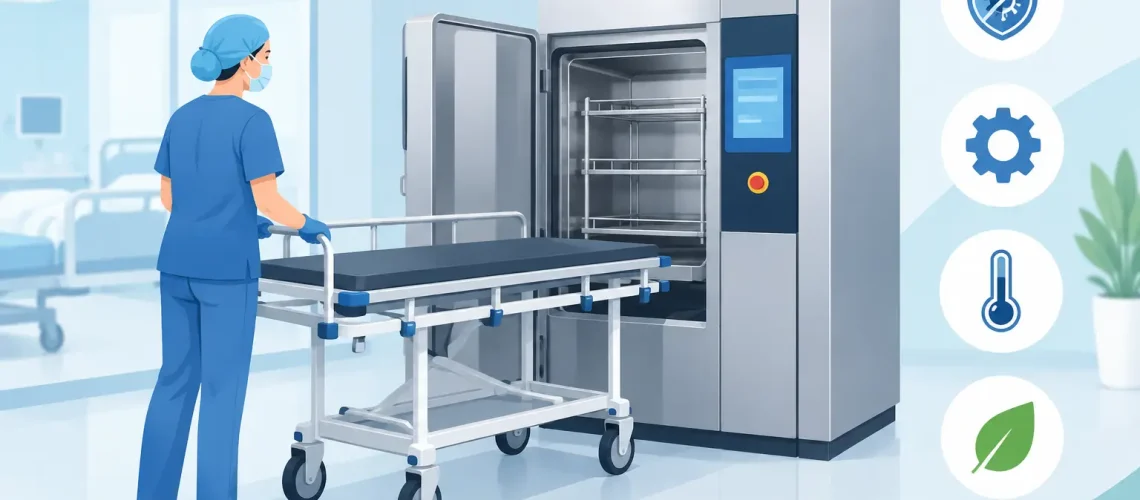
A hospital trolley sterilizer machine is not simply a larger cleaning cabinet. It is a process-control asset that must fit the physical trolley, the contamination risk, the required hygiene outcome, and the facility’s daily movement of people and materials. When these factors are mismatched, even a well-built machine can create delays, unnecessary handling, and uncertainty around sanitation results.
For hospitals, central sterile departments, commercial laundries, food-service areas, laboratories, and hygiene-sensitive facilities, the right system protects more than equipment surfaces. It supports cleaner transport pathways, more repeatable operating procedures, and a safer environment for staff and patients.
Start With the Required Hygiene Outcome
The first question is not chamber size or heating capacity. It is what the process must achieve. The terms cleaning, disinfection, sanitation, and sterilization are often used loosely, but they describe different outcomes and require different validated methods.
A trolley carrying linens, waste, meals, instruments, or supplies may need a specific cleaning and disinfection process before it returns to service. A process described as sterilization must be designed and validated for the applicable load, cycle parameters, and facility requirements. Temperature alone does not prove that a load has received the intended treatment.
This distinction matters during procurement. A facility should define the trolley type, material construction, contamination source, required turnaround time, and internal infection-control or quality requirements before selecting equipment. Stainless steel transport trolleys, powder-coated carts, enclosed cabinets, and wheeled racks can each respond differently to heat, moisture, airflow, and repeated cycles.
A practical specification also identifies what is not going into the machine. Sensitive plastics, electronics, rubber components, lubricated wheels, and temperature-sensitive labels may limit the suitable process. An engineered solution begins with these operating facts rather than an assumption that one cycle suits every trolley.
How a Hospital Trolley Sterilizer Machine Fits the Workflow
Trolley processing is frequently a workflow problem disguised as an equipment problem. If contaminated trolleys cross paths with cleaned trolleys, the facility can lose the hygiene benefit of a controlled cycle. If loading requires excessive manual lifting or repositioning, operators may bypass the intended procedure during busy periods.
The most effective installation considers the full material route: collection, staging, loading, cycle operation, unloading, inspection, and return to service. A pass-through layout can be valuable where a facility needs a clear separation between dirty and clean zones. In other sites, a front-loading configuration may be more practical because of room constraints, existing traffic flow, or lower processing volumes.
Cycle time must also be assessed honestly. A shorter cycle is useful only if it delivers the required outcome across the full load and if the machine can be loaded, unloaded, and released without creating a queue. Capacity planning should consider peak demand, not only average daily volume. A hospital may process a predictable number of food-service carts during normal hours, then face a sharp demand increase after meal service or during heightened infection-control activity.
Critical Design Factors Before You Buy
A trolley sterilizer should be specified as part of the facility, not treated as a standalone purchase. The following factors have the greatest effect on long-term usability and operating consistency.
Chamber dimensions and usable loading space
External machine dimensions are not enough. The chamber must accommodate the actual trolley footprint, height, wheel position, handles, shelves, and any protruding accessories. Allowing only a few inches of clearance can make loading difficult and restrict airflow around the load.
Facilities should measure their largest routine trolley and identify whether multiple trolley designs will be processed. Custom chamber dimensions, rails, guides, ramps, or loading fixtures can reduce handling time and help position loads consistently from cycle to cycle.
Heating, airflow, and temperature uniformity
For thermal systems, controlled temperature distribution is central to process performance. Airflow needs to reach the relevant surfaces without creating poorly treated zones behind solid panels, deep shelves, or tightly packed carts. Load configuration matters as much as heater output.
A capable supplier should discuss circulation design, insulation, door sealing, temperature sensing, controls, and the way the machine will recover after a door is opened. The goal is not simply to reach a setpoint quickly. It is to hold the intended process conditions consistently under real operating loads.
Controls, records, and operator protection
Clear controls reduce dependence on memory and individual operator judgment. Recipes, cycle status indication, alarms, temperature display, access controls, and data recording can support traceability where the facility requires it. The appropriate level of automation depends on risk, throughput, and the site’s quality procedures.
Safety should be built into routine use. This can include insulated surfaces, interlocks, emergency stop functions, door safety arrangements, and controls positioned for safe access. For thermal equipment, consideration should also be given to heat release into the room, ventilation, electrical supply, and the safe movement of hot trolleys after a cycle.
Materials and maintainability
A machine used in a hygiene-critical area must withstand repeated use, cleaning, and inspection. Corrosion-resistant construction, durable seals, accessible service points, and replaceable wear components make a direct difference to lifecycle cost.
Maintenance access is often overlooked during the buying stage. Ask how technicians will inspect heaters, fans, sensors, wiring, seals, and control components. A design that is difficult to service can turn a minor issue into extended downtime. Availability of technical support and practical preventive maintenance planning are equally important, particularly for facilities that operate every day.
Validation Is Part of the Equipment Decision
A machine can be mechanically sound and still be unsuitable if the facility cannot demonstrate that the required cycle is repeatable for its intended load. Validation should be considered before commissioning, not after an audit or an infection-control concern.
The validation approach depends on the technology, intended use, local requirements, and facility policy. It may involve documenting operating parameters, checking temperature distribution and penetration, confirming load arrangements, and establishing routine monitoring methods. The facility’s quality, engineering, and infection-control teams should define acceptance criteria together.
Do not accept a generic cycle claim as a substitute for site-specific verification. Trolley geometry, payload, room conditions, loading density, and operator practices can all affect results. A supplier that participates in installation, commissioning, operator training, and follow-up service provides more value than one that only delivers equipment to the loading dock.
Energy Efficiency Without Compromising the Process
Energy-conscious design is a sensible operational objective, but it should never reduce process reliability. Good insulation, properly sized heaters, efficient air circulation, dependable door seals, and controls that avoid unnecessary idle operation can lower wasted energy while supporting stable cycle conditions.
The best choice depends on how the machine will be used. A continuously active department may benefit from different control logic than a facility with a few scheduled processing windows each day. Recovery time between cycles, standby settings, heat loss, utility availability, and maintenance practices all affect the real operating cost.
It is also useful to look beyond electrical consumption. A poorly planned machine can consume labor through difficult loading, repeated reprocessing, manual documentation, or frequent corrective maintenance. Lifecycle value comes from dependable throughput and fewer interruptions, not from the lowest purchase price alone.
Questions That Improve a Trolley Sterilizer Specification
Before requesting a quotation, facility teams should be ready to discuss several practical details: the number and dimensions of trolleys per shift, expected peak loads, trolley materials, desired process outcome, available utilities, room layout, door access, and documentation needs. Photos or drawings of the existing carts often prevent costly assumptions.
They should also clarify responsibility after installation. Who will train operators? What preventive maintenance is recommended? How are replacement parts and technical support handled? Can the system be adapted if the facility introduces new trolley sizes or changes workflow later?
REK Engineering Machinery approaches these projects as engineered process requirements, with custom fabrication, control integration, installation support, and maintenance planning considered together. That approach is especially valuable where standard equipment dimensions do not match the facility’s actual carts or operating sequence.
A well-specified trolley processing system gives staff a procedure they can follow with confidence, even during the busiest shift. The most useful next step is to map the real trolley journey through the facility, then build the machine and validation plan around that journey.