
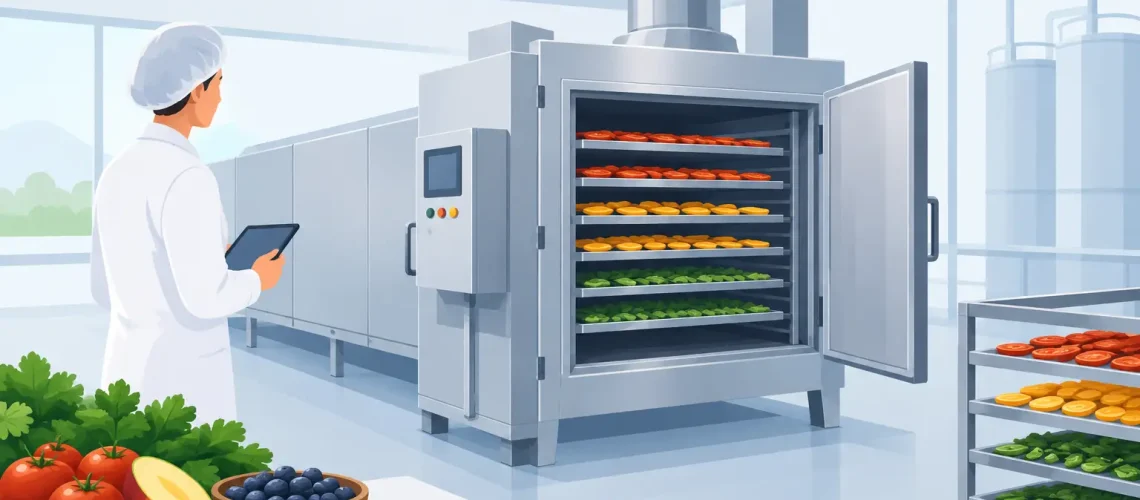
A food dryer is not simply a heated chamber. It is a controlled production step that affects moisture, texture, shelf life, yield, hygiene, and throughput. The right industrial dryer for food processing must remove moisture consistently without scorching delicate ingredients, creating uneven batches, or becoming difficult to clean between product runs.
For plant managers and procurement teams, the decision should begin with the product and process, not a catalog model. A dryer that performs well for trays of herbs may be unsuitable for sliced fruit, powdered ingredients, coated snacks, or products moving continuously through a high-volume line. The best result comes from matching heat transfer, airflow, loading method, controls, and sanitation requirements to the operation on the floor.
Start With the Drying Objective
Every drying project needs a clear production target. Is the goal to extend product shelf life, prepare an ingredient for further processing, stabilize a product before packaging, or remove surface moisture after washing or coating? Each objective changes the acceptable temperature range, final moisture level, residence time, and handling method.
Product sensitivity matters just as much. High heat can damage color, aroma, nutrients, or structural quality in fruits, vegetables, herbs, spices, and specialty ingredients. At the same time, low-temperature drying may require longer cycle times and more floor space. There is no single best operating temperature. The practical choice depends on the product’s moisture profile, allowable processing time, and quality standard.
Before selecting equipment, define four operating inputs:
- Product type, size, thickness, and starting moisture content
- Required final moisture level or water activity target
- Daily production volume, batch size, and expected future capacity
- Cleaning frequency, allergen separation needs, and hygiene procedures
These details give an engineering team the basis to calculate airflow, heating capacity, tray or conveyor area, exhaust requirements, and cycle time. Without them, dryer sizing is often based on assumptions that later limit output or product consistency.
How an Industrial Dryer for Food Processing Controls Quality
Drying is a balance between heat, air movement, humidity removal, and time. Raising temperature alone does not guarantee faster or better drying. If humid air remains around the product, moisture transfer slows down. If air velocity is too high, lightweight materials can shift, curl, or dry unevenly. If airflow does not reach every tray or belt section consistently, one area of the load may meet specification while another remains too wet.
A well-designed system directs conditioned air across the product evenly, then removes moisture-laden air in a controlled way. For batch equipment, this may involve carefully arranged circulation fans, ducting, adjustable dampers, and tray spacing. For continuous systems, belt speed, drying zones, and air distribution must work together so the product receives repeatable treatment from inlet to discharge.
Control capability is equally important. Operators need to set and monitor temperature, time, airflow, and, where applicable, humidity or exhaust settings. Recipes can reduce dependence on manual adjustment when the facility produces multiple products. However, controls should remain practical for the operating team. A complex interface without clear alarms, access levels, and maintenance visibility can create more problems than it solves.
Select the Dryer Configuration Around the Workflow
The correct dryer configuration depends on production volume, product handling, available footprint, and the level of flexibility required. Batch tray dryers are often suitable where several product types are processed in smaller volumes. They allow operators to load materials on trays or trolleys and run controlled cycles, making them useful for operations that prioritize flexibility and separation between batches.
Continuous conveyor dryers can be a stronger fit for stable, high-throughput production. Product moves through one or more drying zones at a defined belt speed, supporting a more consistent flow into downstream cooling, inspection, and packaging. The trade-off is that continuous equipment usually requires a more stable product feed and a process layout designed around line integration.
Cabinet-style, trolley-based, or custom chamber systems may suit facilities with limited space or unusual product geometry. In these cases, the equipment should be designed around loading access, rack movement, cleaning reach, drainage, and safe operator handling. Custom fabrication is especially valuable when standard dimensions do not fit an existing production room or when the dryer must connect with washers, conveyors, cooling stations, or hygiene controls.
Hygienic Design Is Part of Dryer Performance
Food processing equipment must support cleaning as effectively as it supports production. Areas that collect powder, fibers, oils, or condensate can become a sanitation concern and increase downtime. A dryer should be designed with accessible internal surfaces, practical access doors, smooth finishes where appropriate, and components that can be inspected without unnecessary disassembly.
Material selection should reflect the product environment. Stainless steel is commonly preferred in food-contact and washdown areas because it supports hygiene and long-term durability. The exact grade, panel construction, insulation, seals, and drainage arrangement depend on cleaning chemicals, humidity, operating temperature, and corrosion exposure.
Consider how the team will clean filters, fans, trays, trolleys, and air passages. If cleaning requires excessive labor or difficult access, it may not be completed consistently during busy production periods. For plants handling allergens or changing products frequently, separation procedures and cleanability need to be addressed early in the equipment design.
Safety also deserves attention. Heated surfaces, moving trolleys, electrical systems, and high-temperature airflow require appropriate guarding, insulation, emergency stops, interlocks, and clear operating procedures. Good engineering protects the product, but it also protects the people responsible for running the process every day.
Energy Efficiency Should Be Measured in Production Terms
Energy use is a major operating cost, but the lowest rated power consumption does not always produce the lowest cost per pound of finished product. A dryer that runs too slowly, requires frequent rework, or produces inconsistent moisture can consume more total energy across the operation than a properly sized system with stable controls.
Useful efficiency features may include insulated panels, recirculated airflow, variable-speed fans, zoned heating, well-controlled exhaust, and efficient heat sources. The value of each feature depends on the product and duty cycle. For example, aggressive exhaust may remove moisture quickly, but it can also discharge useful heat. Recirculation can reduce heat loss, but it must be balanced with sufficient moisture removal and product hygiene requirements.
Ask suppliers to discuss expected throughput, cycle time, loading density, and operating conditions rather than offering a broad energy claim. The most meaningful comparison is the energy required to produce acceptable, saleable output at the required capacity.
Plan for Installation, Maintenance, and Validation
A dryer is only as dependable as its installation and ongoing support. Site conditions such as electrical supply, ventilation, ceiling height, drainage, access routes, and floor loading can influence the final design. Existing facilities may also need equipment positioned around established material flow, sanitation zones, or packaging lines.
Commissioning should confirm that the dryer reaches operating conditions, airflow is balanced, controls respond correctly, and safety devices function as intended. Product trials are then needed to establish practical recipes for each material. Recording temperature, time, load weight, and final moisture results helps operators build repeatable procedures rather than relying on judgment alone.
Maintenance planning should include fan inspection, heater checks, control panel servicing, seal condition, sensor verification, and cleaning of airflow components. Preventive service reduces unexpected downtime and helps maintain drying consistency as the equipment ages. For custom machinery, access to the engineering team that understands the original design can make troubleshooting faster and more precise.
REK Engineering Machinery approaches these projects as an equipment and process integration challenge. Custom-built drying systems, supported by installation, maintenance, and technical service, allow facilities to address the realities of their products, building constraints, and daily production targets.
The most useful next step is to collect real production data from the line: product moisture before and after drying, batch weights, current cycle times, rejection reasons, cleaning requirements, and anticipated growth. Those facts turn a dryer purchase into an engineered decision that can support reliable food quality for years.