
A powder-coated part can look perfect as it enters the oven and still leave with an uneven, under-cured, or discolored finish. The difference is rarely the powder alone. Powder coating curing ovens must bring every part to the required metal temperature, hold it there for the correct time, and do so consistently across changing production loads.
For manufacturers, this is where finish quality becomes an engineering issue. A curing oven affects adhesion, corrosion resistance, appearance, throughput, energy consumption, and rework rates. Selecting the right system starts with the product, production flow, coating specification, and operating conditions – not simply the oven’s exterior dimensions or maximum air temperature.
What a Powder Coating Curing Oven Must Do
Powder coating is applied as a dry material, then heated until it melts, flows, and chemically cross-links into a continuous protective film. Most conventional powders cure within a defined metal temperature range, often around 350°F to 400°F, but the exact cure schedule depends on the powder formulation and coating supplier’s technical data.
The key term is metal temperature, not just oven air temperature. Thick steel fabrications, cast components, dense assemblies, and tightly loaded racks take longer to absorb heat than thin sheet-metal parts. If a control panel shows the setpoint has been reached, that does not automatically mean the product itself has reached curing temperature.
A properly engineered oven manages three connected requirements: sufficient heat input, controlled airflow, and a stable dwell period after the heaviest part reaches target temperature. When these conditions are repeatable, operators can protect finish quality without unnecessarily extending cycle times.
Start With the Actual Cure Profile
The oven specification should begin with the powder manufacturer’s cure schedule. A common requirement may read as 10 minutes at a stated metal temperature. That requirement does not include the time needed for the part to heat from ambient temperature to the required cure point.
This heat-up period varies by part mass, geometry, material thickness, loading density, hanger design, and incoming part temperature. A light bracket may heat quickly, while a large fabricated frame can require a significantly longer ramp-up time. Using one timer setting for both can create avoidable defects.
Verify temperature at the part
Thermal profiling provides a practical way to establish a dependable process. Temperature sensors are placed on representative areas of a product, particularly thick sections, corners, shaded surfaces, and locations with the greatest thermal mass. The recorded profile shows how long the part takes to reach cure temperature and whether different locations heat evenly.
Profiling is especially valuable when launching a new product, changing powder types, adjusting rack loading, or commissioning a new oven. It turns assumptions into measurable process data and helps define the correct recipe for each product family.
Airflow Is a Finish-Quality Requirement
An oven can have enough installed heating capacity and still produce inconsistent results if airflow does not reach the product uniformly. Air movement transfers heat to the workpiece and removes localized temperature differences within the chamber.
In a well-designed forced-convection curing oven, recirculated air is distributed through ducts, plenums, and adjustable supply openings to move across the load. The return-air path matters just as much. Air must circulate around the parts rather than short-cycle from a supply opening directly back to the return.
Poor airflow can lead to different cure conditions on the same rack. Operators may see gloss variation, incomplete film formation, soft coating, poor adhesion, or color inconsistency. The issue can be more pronounced with large assemblies, deep recesses, densely packed baskets, or products loaded too close to duct outlets and return paths.
Air velocity should not be treated as a simple “more is better” decision. Higher airflow can improve heat transfer, but it must be balanced against the risk of disturbing lightweight parts or creating uneven air patterns. The right approach depends on product size, conveyor or batch layout, loading method, and the finish requirements of the application.
Batch, Conveyor, and Custom Oven Configurations
The most suitable oven configuration follows the production process.
A batch oven is often the practical choice for mixed product sizes, lower to moderate volumes, prototypes, and job-shop environments. It provides flexibility for racks, carts, fixtures, and irregular fabrications. Batch operation can also support different cure recipes, although disciplined loading and process control are needed to maintain consistent results from cycle to cycle.
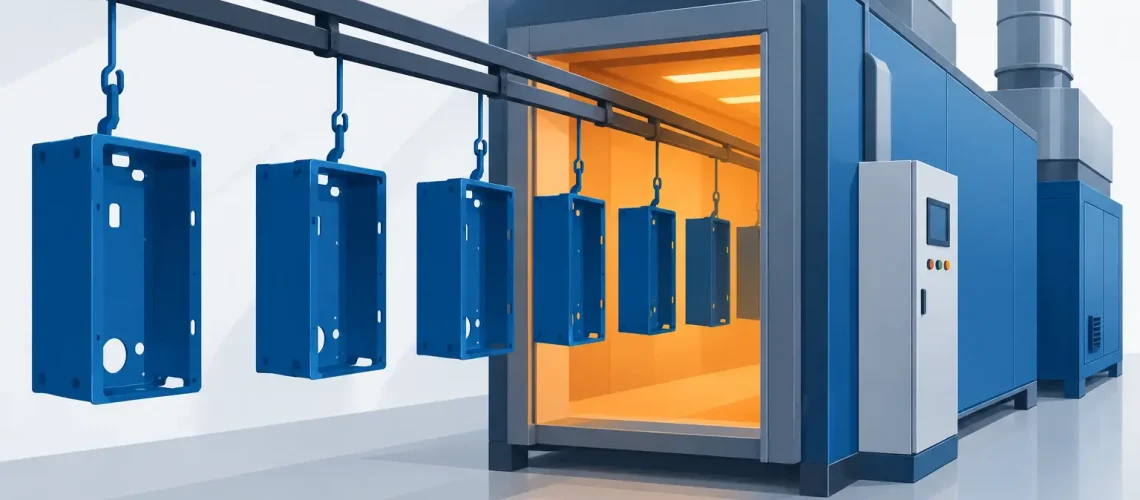
A conveyorized curing oven is designed for repeatable, higher-volume production. Parts move through defined heating and curing zones at a controlled line speed. This arrangement can support predictable output and reduce handling, but it requires careful planning around product spacing, line balance, part orientation, cure time, and future production growth.
Custom-designed powder coating curing ovens are often justified when standard dimensions do not match the workflow. Long components, heavy fixtures, high-mass fabrications, restricted floor space, manual trolley loading, automated conveyors, or specific heat-source preferences may all require tailored chamber dimensions, door arrangements, airflow design, and controls.
Controls Should Support Operators, Not Complicate Them
Reliable curing depends on more than a thermostat. A production oven should have controls that make each run visible, repeatable, and safe. At a minimum, the system needs accurate temperature control, high-temperature protection, fan and heater interlocks, alarms, and clear operating status.
Recipe-based controls can be useful where multiple products or powder systems are processed. Operators can select a predefined cycle with the correct temperature and dwell time, reducing the risk of manual setting errors. For facilities with quality documentation requirements, data logging may provide a record of oven performance and support internal process verification.
Controls should remain practical for the people using them every shift. An overly complex interface can create workarounds, missed alarms, and inconsistent operation. The strongest design pairs appropriate automation with clear displays, logical fault messages, and accessible maintenance functions.
Energy Efficiency Starts With Oven Design and Discipline
Curing ovens operate at elevated temperatures for extended periods, so energy performance has a direct effect on operating cost. Insulation quality, door sealing, heat-loss control, recirculation design, burner or electric heater efficiency, and exhaust settings all influence consumption.
Exhaust is necessary to manage moisture, contaminants, and volatile compounds released during the process, but excessive exhaust removes heated air that must be replaced and reheated. The required exhaust rate should be determined with safety and coating-process needs in mind, rather than set higher than necessary.
Daily operating habits matter as well. Frequent door opening, loading cold parts beyond the oven’s intended capacity, leaving an oven at full temperature during long idle periods, and failing to repair damaged seals can all increase energy use and affect cure consistency. Preventive maintenance protects both performance and cost control.
Installation Details That Affect Long-Term Reliability
An oven’s performance is influenced by what happens around it. The installation must account for electrical supply or fuel connection, ventilation, clearance for service access, safe loading routes, floor loading, and integration with pretreatment, spray booth, cooling, and material-handling areas.
The layout should prevent bottlenecks. If coated parts wait too long before curing, contamination or coating damage can occur. If cured parts have no designated cooling area, operators may handle hot work unsafely or interrupt the production flow. A well-planned line considers the entire movement of the product, from preparation through final inspection.
Maintenance access should be part of the original design. Fans, bearings, heaters, sensors, filters, control components, and ductwork will require inspection over the life of the equipment. Equipment that is difficult to service is more likely to remain out of specification until defects become visible in finished parts.
Choosing an Engineering Partner for the Oven
The right supplier should ask detailed questions before recommending a configuration. Useful discussions cover part dimensions and weight, maximum and average load, coating chemistry, target throughput, available utilities, floor layout, loading method, safety requirements, and expected production changes.
REK Engineering Machinery approaches thermal processing equipment as a complete operating system, combining custom fabrication, controls, installation support, and ongoing maintenance planning. This matters when curing requirements must fit real facility constraints rather than an off-the-shelf machine footprint.
A curing oven is not simply a heated chamber. It is a controlled production asset that determines whether the coating process delivers the durability and appearance customers expect. When heat transfer, airflow, controls, loading practice, and service access are designed together, the oven becomes easier to operate, easier to maintain, and far more dependable over its working life.
Before committing to a new system, bring representative parts, actual powder specifications, and realistic production forecasts into the design conversation. The best curing result is built into the process long before the first coated part enters the oven.